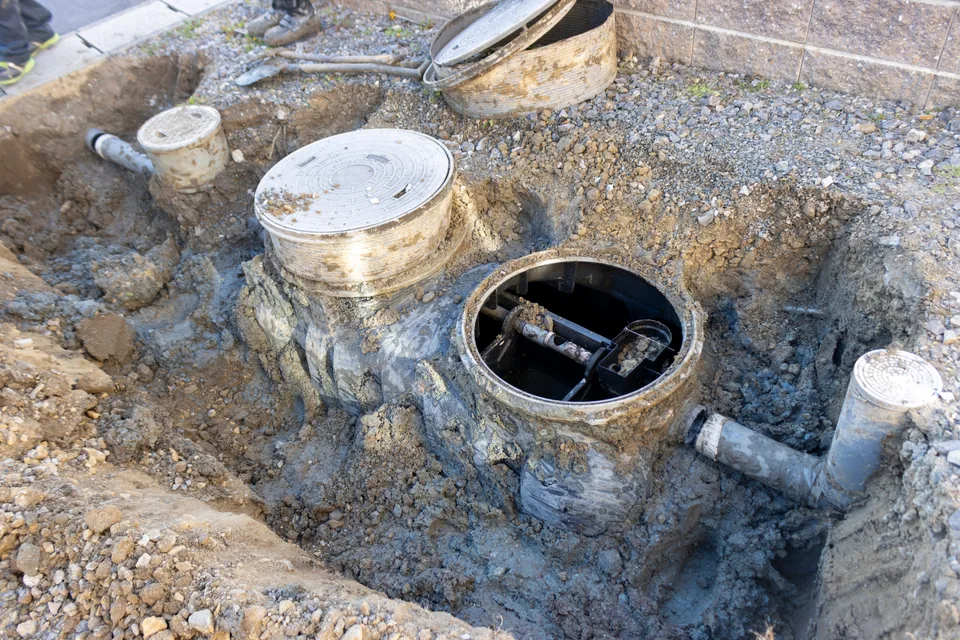
Wyoming does not license the people who install septic systems — not at state level. There is
no statewide installer license, no statewide certification and no statewide registration, and
a page that stopped there would mislead you badly, because in several Wyoming counties a great
deal is asked. Where a county has adopted a small wastewater systems contractor license, the
county writes it as a prohibition on the person doing the work. Laramie County Small
Wastewater System Regulations Section 16(a): “No person except as in (b), shall install, engage
in the installation of, or repair a small wastewater system unless he holds a valid Systems
Contractor License.” The same section then takes two classes of person out of the license. Employees are written
out — “Employees of a validly licensed Systems Contractor shall not be required to be
licensed.” — and so is the owner of the land, at Section 16(b): “Any landowner of record may
install a small wastewater system for his own use without the necessity of obtaining a license,
provided however, such landowner shall first obtain a permit from the Cheyenne-Laramie County
Health Department upon a proper showing to the department of competency to complete the said
work in accordance with these regulations”. That is the first limb of the scope, and the second
limb is geography. The duty reaches only the counties whose own regulations create such a
license. No Wyoming statute and no Wyoming administrative rule lays a floor underneath them, so
a county that has adopted none imposes none — and counties read for this page attach no
installer credential to the trade at all. So the requirement is neither universal nor absent.
It reaches the contractor who is paid to do the work, in the counties that have written it, and
it does not reach the whole state. And in none of those counties does the license authorize a
job: the credential says who may do the work and the permit says this system may be built here.
They are separate instruments and neither one substitutes for the other.
Because the county supplies the credential or does not, the permit is the layer worth
understanding first — the state supplies it wherever the county does not. W.S. 35-11-304(a) delegates to a qualifying county,
among other things, the authority “to review and approve construction plans, conduct
inspections and issue permits”, and where a county has not taken that delegation the same
functions stay with the Department of Environmental Quality, Water Quality Division. The state
also sets a condition on who may hold the inspecting role, at W.S. 35-11-304(a)(iv), in terms
of “a registered professional engineer or city or county sanitarian for small wastewater
facilities or other qualified individual approved by the water quality division administrator”.
Design is reached the same way — not through a designer credential, which Wyoming does not
issue, but through the professional engineer seal on stated triggers. Water Quality Rules
Chapter 25 Section 2 names non-domestic wastewater from commercial and industrial facilities,
high strength wastewater, individual permits to construct, and soil percolation rates outside a
stated band; Chapter 3 Sections 4(a)(iv) and 5(f) require the seal on plans, specifications and
reports submitted under that chapter. One live ambiguity is worth carrying in the job file
rather than in your head: in Campbell County the state agency and the county publish different
answers about which of them permits a commercial system, and neither statement is treated here
as settled. Ask which counter, and write down who told you.
Pumping and hauling runs on the same divided shape and a different instrument. No state permit,
license or registration attaches to whoever pumps or transports septage in Wyoming; the state’s
instrument sits on the place where the material ends up, rather than on the truck or the
operator. A hauler credential, where one exists, belongs to the county, and in the exemplar
county it is a prohibition in the same style as the installer one. Section 17(a): “No person shall
engage in the cleaning of a small wastewater system or the transportation of sewage to a
disposal site unless he holds a valid Waste Haulers License”. Employees again are written out —
“Employees of a validly licensed Waste Hauler shall not be required to be licensed.” — so this
is one license held by the business, with two surfaces. The second surface is the equipment.
The vehicles are not separately licensed and they are separately inspected: “An annual
inspection of the waste haulers vehicles shall be conducted prior to license renewal.” And they
are marked, at Section 17(a)(i): “The company name and license number shall be posted on both
sides of the vehicle cab in letters at a minimum of six (6) inches high.” Two conditions of
that license are ours. The first is insurance on the face of the credential, at Section
17(a)(iii): “Proof of liability insurance shall be required prior to the issuance and renewal
of a license.” No limit is stated in the regulations, so the county requires the coverage and
leaves the amount to the market, and because the proof is required prior to renewal, a lapse is
a licensing problem before it is an insurance one. The second is where the
load may go, at Section 17(b)(iii): “A license holder shall dispose of the collected
non-hazardous liquid waste only at a site approved by the Laramie County Board of County
Commissioners, the Cheyenne-Laramie County Health Department and the Wyoming Department of
Environmental Quality.” So the disposal-site restriction pulls in all three tiers at once: three approvals for one load.
Wyoming issues no credential to inspect or evaluate an existing septic system, and inspection
is still done — by the permitting authority’s staff, under the permit, which is why those two facts have to travel together. What the state regulates
instead is set out under Inspecting and evaluating below, with the authority for each part of
it, so this page will not restate it here. What a contractor should take from it is narrower.
An inspection of the new installation is required under the permit in every regime read for
this page, and in the exemplar county the duty to call for it is put on the credential holder —
Section 16(c)(v): “Notice of a requested inspection shall be given by the license holder not
less than twenty-four (24) hours before the inspection is to be made.” Miss that notice and the
license holder has not called for the inspection the permit requires. At a property
transfer, where a Wyoming county runs an evaluation program at all, the evaluation is performed
by that county’s own environmental health staff and it is driven by lender practice rather than
by a state duty. The exposure is easy to miss because no license marks it: a contractor who gives a buyer, a seller or a lender an opinion on an existing system in
Wyoming is doing uncredentialed work that somebody is relying on in a transaction, with no
state certification to point at as a standard of care and no state body that will have reviewed
the opinion.
The sharpest way to see what Wyoming has decided about this trade is to stand on a rural lot
and look at the two holes in the ground. The well is a licensed trade statewide. W.S.
33-42-103(f): “It shall be unlawful for any person to construct, alter or rehabilitate a water
well or install pumping equipment in a water well without a license as provided by this act
unless the activity is exempted from the licensing requirements of this act.” That act even
splits itself in two, at W.S. 33-42-103(c): “The licensing of water well drilling contractors
and the licensing of water well pump installation contractors are separate and distinct
activities.” The septic system on the same lot has no statewide credential at all — though the
county it sits in may well attach one, and the permit on the system is a separate instrument
either way. A contractor
who digs both is regulated as a person for one half of the job and as a permit holder for the
other, under two different bodies. And the one place the trade is named in the whole of
Wyoming’s professions title is an exemption: among the individuals the Professional Geologists
act exempts from its licensing provisions, W.S. 33-41-117(a)(ix) lists “Individuals engaged in
the practice of subsurface sewage disposal;”. The legislature named this work in order to say
that a credential does not reach it — which is worth knowing before a search result convinces
you otherwise.
There is a third layer, it is municipal, it is blind to this trade, and it carries the
insurance conditions that matter most. The state’s largest city licenses building-trade
contractors through its own board. City of Cheyenne Contractor Licensing Regulations Section
3.1: “No person may perform work, services or advertising related to the construction,
erection, addition, alteration, repair, equipping, moving, removal, conversion or demolition of
any building or structure within the City without having obtained the contractor and building
trade licenses required by the Ordinances and the City of Cheyenne Contractor Licensing
Regulations.” Those regulations never mention septic work or small wastewater, so this is a
companion credential and not the septic one — the nearest class in them is a sewer and water
main subcontractor license, which is mains work rather than on-site disposal. But its
conditions are ours twice over. Section 3.4: “A contractor license shall not be issued until a
current certificate of insurance has been filed and approved by the building department.” And
Section 3.2: “No license shall be issued by the City until the required certificate of
insurance and Wyoming workers compensation letter of good standing has been provided.” The
minimum limits are published by license class in those same regulations; they are a municipal
figure that can move, so read them rather than take a number off a page. Put the three layers
together and a contractor working inside that city can be under three instruments on one job —
the county health department’s systems contractor license, the city’s building-trade license,
and the permit on the system — none of which substitutes for either of the others, and two of
which are conditioned on coverage staying in force. That turns a cancellation notice into a
work stoppage.
Workers compensation is the Wyoming answer that surprises contractors who have run a crew
anywhere else. The statement of it, with its citations, is in the workers compensation block
below. What that block does not carry is what follows from it, and four things do. This trade
is in the schedule twice over. W.S. 27-14-108(a)(ii) sets the method — “Regardless of individual
occupation, all workers employed in the following sectors, subsectors, industry groups and
industries, as each is defined in the most recent edition of the North American Industry
Classification System (NAICS) manual:” — so the question is which industry the business sits
in, not what a given worker did that day. The installer is reached by (a)(ii)(D), “Construction,
sector 23;”, and the pumper by (a)(ii)(M)(II), “Subsector 562, waste management and remediation
services.” A Wyoming business that installs and pumps sits in two covered classes. Next, that
classification is the division’s to make and yours to contest, and the burden is not where you
would expect: W.S. 27-14-201(a) provides that “Employments affected by this act shall be
divided by the division into classes, whose rates may be readjusted annually as the division
actuarially determines. Any employer may contest his classification as determined by the
division following the contested case provisions of the Wyoming Administrative Procedure Act
except that the division shall carry the burden of proving that the classification is correct.”
Third, the owners are outside by default. The act’s definition of employee excludes by person
rather than by industry — casual labor, the independent contractor, the sole proprietor, the
partner, the corporate officer, the limited liability company member. An employer electing
under W.S. 27-14-108(k), the door back in by written election, “shall not withdraw coverage at
any time during the subsequent eight (8) calendar quarters”, so the election is a commitment.
Fourth,
and this is why a Wyoming septic sub is asked for paperwork constantly: on private work the
subcontractor rule at W.S. 27-14-206(e) leaves the general contractor answerable for the
premiums a subcontractor has not paid, and on public work W.S. 27-14-206(b) makes it a checking
duty — “The prime or general contractor shall secure certification when a contract is awarded
or before permitting a subcontractor to begin work, that the subcontractor has in good standing
an account under this act that covers all coverable employees in the employ of the
subcontractor.” So the document being asked for is not a certificate from an insurer. It is
evidence of a good-standing account with the state division — the same document the state’s
largest city wants before it will issue a building-trade license.
Read together, a Wyoming septic business answers to a county credential where one exists, a
permit from the county or the state, a city license where a city requires one, and one state
fund account — and only the state fund account is the same everywhere. Where a county credential
exists it can be lost, and a revocation is not a quiet event — Section 16(d)(iii) provides that
“A systems contractor whose license has been revoked may not be considered for re-licensing for
at least one year following the revocation date.” Losing it does not lift the permit
requirement, because the county license and the permit on the system were never the same
instrument and never covered for one another. Where no county credential exists, the public
record cannot tell a careful installer from a careless one, so the certificate of insurance
ends up standing in for the license a neighboring county would require. The sections below set out
each axis with the authority it rests on and a link to the source, so you can check the law
rather than take this page’s word for it. Tell us which counties you actually work in and what
you do when you get there, and we will tell you which of these reaches you.