Skip to content

California

Septic Contractor Insurance in California

California issues no septic installer license of its own — the credential a septic contractor here holds is a state contractor classification, and the one septic-specific registration in this state is issued locally.

Get a quote Call 317-942-0549

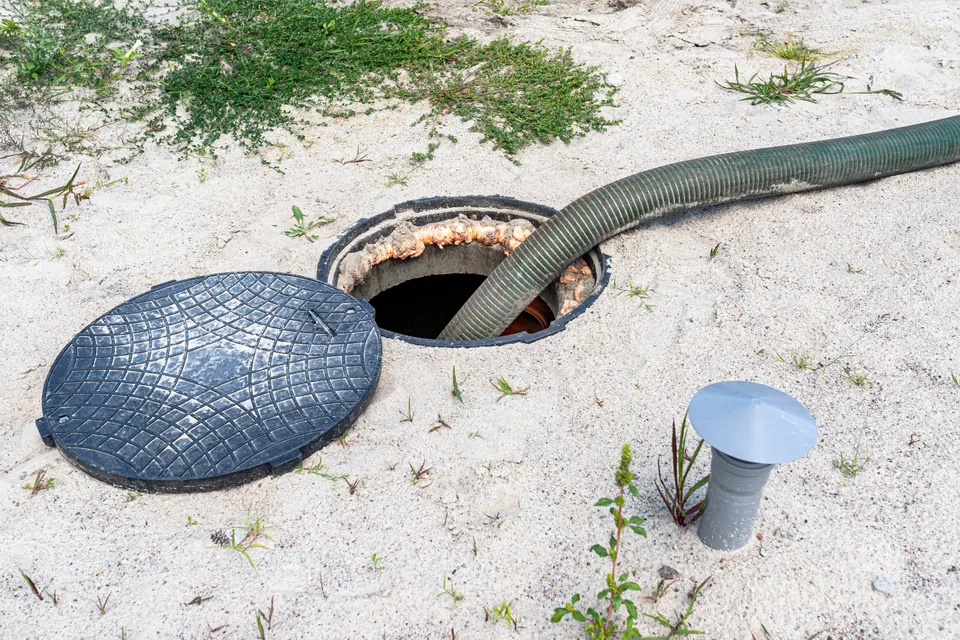
An open septic tank riser with its lid set aside and a suction hose inside — septic contractor insurance in California

California issues no septic installer license, and that is a finding rather than a gap. There is no septic examination board in this state, no septic registry and no septic continuing education to complete. What a septic installer here actually holds is a contractor license classification, issued by the Contractors State License Board — Class C-42, Sanitation System Contractor, created by regulation at Cal. Code Regs., tit. 16, § 832.42, which describes the class in one sentence: “A sanitation system contractor fabricates and installs cesspools, septic tanks, storm drains, and other sewage disposal and drain structures.” That is a construction license with a sanitation scope. It is not a septic credential in the sense most other states use the phrase. The credential a California installer holds is a general construction license, not a septic-specific one, and holding it demonstrates no septic competence. Because it is a contractor license and not a septic one, it can be suspended over matters that are not septic work at all — a workers compensation lapse suspends the license by operation of law, as the last paragraph but one sets out.

Two bodies run this, and they are not two views of one rule. The Contractors State License Board issues and classifies the license. The State Water Resources Control Board owns the statewide septic rule — the onsite wastewater treatment system policy — and issues no credential at all. The statute behind that policy is four sections long, and the duty in it runs to the state board rather than to anyone doing the work: Wat. Code § 13291(a) puts the duty to adopt standards on the board, and § 13291(b)(3) requires those standards to include “Requirements authorizing a qualified local agency to implement those requirements adopted under this chapter within its jurisdiction if that local agency requests that authorization.” So the chain is worth stating plainly, because merging its two halves is the error most available in this state: the water policy does not license anybody, it names a license somebody else issues, and that naming is what puts the classification on the installer.

The naming sits at § 8.2.5 of the policy, and it does not reach every person who may lawfully put a system in the ground. The section names four classifications — a general engineering contractor (Class A), a general building contractor (Class B), a sanitation system contractor (Class C-42) or a plumbing contractor (Class C-36) — one of which “shall install all new OWTS and replacement OWTS in accordance with California Business and Professions Code Sections 7056, 7057, and 7058 and Article 3, Division 8, Title 16 of the California Code of Regulations”. The same section then keeps open a route for somebody who is not a contractor at all: “A property owner may also install his/her own OWTS if the as-built” — the sentence continues past a page break in the published text — “diagram and the installation are inspected and approved by the Regional Water Board or local agency at a time when the OWTS is in an open condition (not covered by soil and exposed for inspection).” An owner installing on their own land, inspected while the work is still open, is the operator that classification sentence leaves outside it. The second limb is structural rather than personal: § 8.2.5 is a Tier 1 standard, and a Local Agency Management Program “may include standards that differ from the Tier 1 requirements for new and replacement OWTS contained in Sections 7 and 8”, and once approved it “shall supersede Tier 1 and all future OWTS decisions will be governed by the Tier 2 Local Agency Management Program”.

What is scoped there is the policy’s naming of acceptable classifications, and nothing wider. A Tier 2 program can supersede § 8.2.5, and the licensing duty still does not go away, because the two instruments live in different codes. Bus. & Prof. Code § 7028(a)(1) is a statute: under it “it is a misdemeanor for a person to engage in the business of, or act in the capacity of, a contractor within this state” while “not licensed in accordance with this chapter”, and a local water-quality program cannot repeal a statute. The contracting code’s own small-job exemption does not rescue the point either: § 7048(a) is conjunctive, and its second limb — that the work not require a building permit — closes it on this trade, because onsite construction runs through a permit in every tier of the policy. Read the two together and the scope is narrow and specific: an owner, on their own system, under an open-condition inspection. Not the crew that took the job.

Pumping and hauling is the axis where California does have a septic-specific credential, and it is shaped as the mirror image of the first one — the duty is a state statute, and the registration is issued locally. Health & Saf. Code § 117405 bars the business without that registration, and its full reach is summarized below the body. The condition it closes on is the part to read: the business may not run “unless he or she or it shall hold an unrevoked registration issued by the local health officer or his or her duly authorized representative of the city, town, county, or city and county for the carrying on of the business”. Note the four tiers the statute names, twice over in the full sentence: the counter is your local health officer, and in much of the state that officer sits in a county environmental health division — but the statute does not say county, and a reader sent to a county office on the strength of the statute has been sent on an assumption. Two duties run rather than one, and the second is the one pages forget: § 117410 reaches the individual who does the cleaning or the disposal, not only the firm on the register. The registration follows an examination rather than a desk check, and the outlet is part of what is examined — it issues “only after examination of the place or places and manner of disposal of the cleanings proposed by the applicant” — so losing a disposal site is a compliance event and not merely a logistics one. It also runs on the calendar and not on an anniversary: “Registration shall be only for the unexpired portion of the calendar year in which application is made, and at the end of the calendar year all registrations shall become void and of no effect.” The exemption in this article reaches governments cleaning systems they own and operate, and it is not an exemption for a private contractor working under a public contract. Where the cleanings go is a separate instrument again — Wat. Code § 13260(a)(1) puts a report of waste discharge on the discharger — and no particular regional board’s terms are described here, because none was read into the record this page is written from.

Nobody is certified as a septic inspector in California, at any level of the state. The statewide policy does not use the word inspector once: it regulates the act of inspection and names no person to perform it. What it does require, for evaluating a site and designing a system, is a qualified professional — “A qualified professional shall perform all necessary soil and site evaluations for all new OWTS and for existing OWTS where the treatment or dispersal system will be replaced or expanded.” — and it defines that term by pointing outward at credentials that are not septic credentials: “an individual licensed or certified by a State of California agency to design OWTS and practice as professionals for other associated reports, as allowed under their license or registration”, which the policy says may include a registered environmental health specialist, a professional engineer or a professional geologist. For site evaluations it also admits soil scientists certified by a private scientific society, which is not a State of California agency and must not be read as one. And the definition is not even fixed: “A local agency may modify this definition as part of its Local Agency Management Program.”

That hand-off is the denominator for the whole state. Among the things a Local Agency Management Program submission must address, the policy lists “Any educational, training, certification, and/or licensing requirements that will be required of OWTS service providers, site evaluators, designers, installers, pumpers, maintenance contractors, and any other person relating to OWTS activities.” California did not leave the certification question unanswered; it put it somewhere else on purpose, which is why there is no state septic register to look anyone up in. One published example, cited to the jurisdiction that publishes it and generalized to nowhere else: the City of Malibu, in Los Angeles County, states on its own operating permit program page that “Onsite Wastewater Treatment System (OWTS) practitioners working within city limits are required to register with the City.”, lists designers, installers, inspectors and operation and maintenance as separate registered categories, and states that “City-registered professionals are required to attend or complete a qualified training program every two years in order to renew their registration.” That is one city’s program and it is California law nowhere else; it is here because it is retrievable evidence that the local layer is real. Read as exposure, a register of that shape is a second credential a policy period can outlive, sitting with a body the state does not backstop.

Workers compensation is compulsory here from the first employee, and the exceptions are classes of person rather than a headcount. Lab. Code § 3700 opens “Every employer except the state shall secure the payment of compensation in one or more of the following ways”, and the two ways, set out in full below, are insurance with an authorized insurer or a certificate of consent to self-insure from the Director of Industrial Relations. The state-created fund sits inside the first route rather than beside it: the statute requires it to be “fairly competitive with other insurers”, and it is deemed admitted to write this class of insurance. The exceptions that can touch a septic business are waivers executed by an owner, officer, general partner or managing member, and a waiver is not coverage: the statute puts the person who signs one under “a conclusive presumption” that the benefits do not reach them, and employees cannot be waived out at all. California then adds an edge found on no other axis of this page. Bus. & Prof. Code § 7125(a) makes that coverage “a condition precedent” to holding the license at all, and under § 7125.2 a lapse suspends the license by operation of law from the day coverage ends — so a lapse is not only an uninsured week here, it is an unlicensed week, and every contract signed inside it carries the consequences the contracting code attaches.

Almost none of that is an insurance requirement. The single place where the credential question and the coverage question touch is the workers compensation certificate the contractor license turns on. The sections below set out each one with the authority it rests on, so you can check it rather than take our word for it.

What California requires of a septic business

Installing

CALIFORNIA HAS NO SEPTIC-SPECIFIC INSTALLER CREDENTIAL. The credential a California septic installer actually holds is a CONTRACTOR’S LICENSE CLASSIFICATION — Class C-42, Sanitation System Contractor, one of the 46 classifications the Contractors State License Board publishes. The statewide septic instrument, the State Water Resources Control Board’s OWTS Policy, creates NO credential of its own: at section 8.2.5 it NAMES four CSLB classifications and requires one of them to install every new and replacement system. So the credential a California installer must hold is issued by a state agency and is a general construction license rather than a septic one, and the underlying statute — Bus. & Prof. Code § 7028(a)(1) — binds the installer directly, not the local agency.

Authority Bus. & Prof. Code, §§ 7026, 7028(a)(1), 7048(a), 7055, 7058(a), 7059(a); Cal. Code Regs., tit. 16, § 832.42; Wat. Code, §§ 13290(a), 13290(b), 13291(a), 13291(b)(3), 13291(c), 13291(d); State Water Resources Control Board, Water Quality Control Policy for Siting, Design, Operation, and Maintenance of Onsite Wastewater Treatment Systems (OWTS Policy), §§ 8.1.1, 8.2.5, 9.2.4, and the Tier 2 preamble — read the source

Pumping and hauling

California DOES run a septage credential, it IS septic-specific, and it is the mirror image of the installer credential: the DUTY is a state statute that applies in every city, town and county in California, and the REGISTRATION is issued by the LOCAL HEALTH OFFICER. Health & Safety Code § 117405 makes it unlawful to carry on the business of cleaning septic tanks, chemical toilets, cesspools or sewage seepage pits, or to dispose of the cleanings, without an unrevoked registration from that officer — and § 117410 reaches the individual doing the work, not only the firm.

Authority Health & Saf. Code, §§ 117400, 117405, 117410, 117415, 117420, 117425, 117430, 117435(a) and (c), 117440, 117445, 117450; Wat. Code, § 13260(a)(1) and (b); Wat. Code, § 13050 (as cross-referenced by § 117435(c)) — read the source

Inspecting and evaluating

California certifies no septic inspector at any level of the state. The statewide OWTS Policy does not use the word inspector once. What the Policy DOES require for the evaluation and design side is a "qualified professional", and it defines that by pointing at credentials that are not septic credentials — a registered environmental health specialist, a licensed professional engineer, a professional geologist — and, for site evaluations only, at a private society’s soil-scientist certification. Certification of inspectors, installers and pumpers is a matter the Policy hands to the local agency.

California issues no septic inspector credential, yet the work behind a permit is not open to all: for a new, replaced or expanded system, the soil and site evaluation and the design must come from a qualified professional, such as a state-registered environmental health specialist, professional engineer or professional geologist, while any credential for inspectors is left to the local agency, which may also redefine who counts as a qualified professional.

Authority State Water Resources Control Board OWTS Policy, §§ 7.1, 8.1.1, 9.2.4, 10.14, 10.15 and the definitions of "Qualified professional" and "Service provider"; Health & Saf. Code, §§ 106600, 106605; Malibu Municipal Code, ch. 15.44 (as cited by the city’s own program page) — read the source

Workers compensation

California requires every employer except the state to secure the payment of compensation either by being insured "against liability to pay compensation by one or more insurers duly authorized to write compensation insurance in this state" or by securing from the Director of Industrial Relations "a certificate of consent to self-insure" — and the state’s own fund is one of those authorized insurers rather than the only one, because California’s statute makes it "fairly competitive with other insurers" and lets it transact this business "to the same extent as any other insurer".

Authority Lab. Code, §§ 3700, 3700(a), 3700(b), 3700(c), 3700.5(a), 3351(d), 3352(a), 3352(a)(16), 3352(a)(17), 3352(a)(18), 3352(a)(19), 3352(b)(1); Ins. Code, §§ 11770(a), 11773, 11775, 11776, 11778; Bus. & Prof. Code, §§ 7125(a), 7125(b)(1), 7125(b)(2), 7125(e)(1), 7125(i), 7125.2(a) — read the source

What California requires of a septic business — installing, hauling, inspecting and workers’ comp from private insurers or a state fund — and what each requirement leaves to the insurance program.

A panel for California in rows. Each row sets one thing the state requires beside the exposure that requirement leaves open and the coverage line that answers it. Installing: There is no septic-specific installer credential at the state level. It leaves open a failed install or drainfield, damage to the customer’s property, which General Liability and Pollution Liability answer. Pumping and hauling: A septage hauling permit is on the books. It leaves open a spill or release in transit, the truck at fault, which Commercial Auto and Pollution Liability answer. Inspecting and evaluating: No statewide inspector or evaluator certification; it varies locally. It leaves open a missed defect in an inspection or design, which Professional Liability answers. Workers compensation: Compulsory for covered employers; private insurers and a state fund write it. It leaves open an injured employee in the trench or on the truck, which Workers Compensation answers. Notes: A license, permit or bond is not a policy — a bond secures the public body that requires it, not the customer. The conclusion reads: The credential is not the coverage — the program is. No figures are shown.

Where we write in California

Sacramento · Sacramento County

California is the state where a workers compensation lapse and a license lapse are the same event: Bus. & Prof. Code § 7125.2 suspends the license by operation of law on the date coverage lapses. An account whose certificate is late is not merely uninsured for a week — it is unlicensed for a week, and every contract signed in that window is exposed to the unlicensed-contractor consequences the code attaches.

Redding · Shasta County

Long-radius rural work means more windshield time per job and more of the policy’s exposure sitting in the vehicle rather than at the dig — and a tank truck running a long rural route under the septage credential is carrying its cargo past the point where a spill stays on the customer’s property.

Santa Rosa · Sonoma County

Where a local program supersedes the state standards, the design a contractor built to last year may not be the design the agency accepts this year, and a completed-operations argument can turn on which program governed the day the system was permitted.

Fresno · Fresno County

A rule that turns on a measured distance to a sewer line puts a siting judgment at the front of every job on a developing fringe, and a system installed where the agency later says sewer was available is a replacement dispute, not a repair.

Bakersfield · Kern County

Work taken as a subcontractor is where additional-insured wording, contractual liability and the general contractor’s own certificate requirements arrive on a septic account — and where a certificate the insured cannot produce stops a job rather than merely annoying an underwriter.

Placerville · El Dorado County

Sites that fail on soil depth push work toward engineered and supplemental-treatment designs, which the Policy ties to ongoing monitoring, alarms and a service provider — more moving parts, more of them outside the installer’s control, and a longer tail on the completed work.

Malibu · Los Angeles County

A local register with a periodic training condition is a second credential a policy year can outlive, and it is held by a city that the state does not backstop — there is no state septic register to fall back on if the local one lapses.

San Diego · San Diego County

A contractor whose week runs from backcountry replacements to urban repairs is carrying rural excavation exposure and developed-corridor underground-utility exposure in the same policy period, on the same license.

California questions we get asked

Does California license septic installers?

Not as a trade. California issues no septic installer license, there is no septic licensing board to find, and the statewide onsite wastewater policy creates no credential of its own. What a septic installer here holds is a contractor license classification issued by the state — Class C-42, Sanitation System Contractor, created by regulation at Cal. Code Regs., tit. 16, § 832.42, which describes the class in a sentence: “A sanitation system contractor fabricates and installs cesspools, septic tanks, storm drains, and other sewage disposal and drain structures.” It is a construction license with a sanitation scope, not a septic one.

Who is outside the classification requirement in the state policy?

Two things sit outside it, and both are in the policy’s own sentence. First a class of person: § 8.2.5 names four contractor classifications for new and replacement systems and then keeps open a route for the owner of the property — “A property owner may also install his/her own OWTS if the as-built” … “diagram and the installation are inspected and approved by the Regional Water Board or local agency at a time when the OWTS is in an open condition (not covered by soil and exposed for inspection).” Second the tier structure: § 8.2.5 is a Tier 1 standard, and a Local Agency Management Program “may include standards that differ from the Tier 1 requirements for new and replacement OWTS contained in Sections 7 and 8”, and once approved it “shall supersede Tier 1 and all future OWTS decisions will be governed by the Tier 2 Local Agency Management Program”. What is scoped there is the policy’s naming of acceptable classifications. The contracting statute is in a different code and a local water-quality program does not reach it: under Bus. & Prof. Code § 7028(a)(1) “it is a misdemeanor for a person to engage in the business of, or act in the capacity of, a contractor within this state” while “not licensed in accordance with this chapter”.

Is pumping and hauling septage a separate credential here?

Yes, and it is the one septic-specific credential California actually has. Health & Saf. Code § 117405 puts a registration between a pumping business and its work: it is unlawful to engage in that business, or to dispose of what is cleaned out of a system, “unless he or she or it shall hold an unrevoked registration issued by the local health officer or his or her duly authorized representative of the city, town, county, or city and county for the carrying on of the business”. Two duties run, not one: § 117410 puts the duty on the individual who cleans or disposes, and not on the firm alone. And it runs on the calendar rather than on an anniversary — “Registration shall be only for the unexpired portion of the calendar year in which application is made, and at the end of the calendar year all registrations shall become void and of no effect.”

Does California certify septic inspectors?

No. There is no septic inspector certification anywhere in California’s state structure, and the statewide policy does not use the word inspector once — it regulates the act and names no person to do it. What it requires for evaluation and design is a qualified professional: “A qualified professional shall perform all necessary soil and site evaluations for all new OWTS and for existing OWTS where the treatment or dispersal system will be replaced or expanded.” The policy then defines that term by pointing outward at credentials that are not septic credentials, and adds that “A local agency may modify this definition as part of its Local Agency Management Program.” Whether an inspector needs a credential where you work is a local question.

Can a city or county add requirements of its own?

It can, and the state policy is where that is written. Among the things a Local Agency Management Program submission must address, the policy lists “Any educational, training, certification, and/or licensing requirements that will be required of OWTS service providers, site evaluators, designers, installers, pumpers, maintenance contractors, and any other person relating to OWTS activities.” So the state answer is a floor and never the whole answer. One published example, cited to the jurisdiction that publishes it and generalized to nowhere else: the City of Malibu, in Los Angeles County, states on its own operating permit program page that “Onsite Wastewater Treatment System (OWTS) practitioners working within city limits are required to register with the City.” and that “City-registered professionals are required to attend or complete a qualified training program every two years in order to renew their registration.” Ask your local agency and your local health officer, in those terms — the statutes here name cities, towns, counties, and cities and counties alike.

Do I need workers compensation, and what happens to the license if it lapses?

The duty is compulsory from the first employee — Lab. Code § 3700 opens “Every employer except the state shall secure the payment of compensation in one or more of the following ways”, and the two ways, set out in full below, are insurance with an authorized insurer or a certificate of consent to self-insure from the Director of Industrial Relations. The exceptions that can touch this trade are waivers executed by an owner, officer, partner or managing member, and a waiver is not coverage: § 3352(a) puts the person who signs one under “a conclusive presumption” that the benefits do not reach them, and employees cannot be waived out at all. Then an edge found on no other axis of this page: Bus. & Prof. Code § 7125(a) makes that coverage “a condition precedent” to holding the license at all, and under § 7125.2 a lapse suspends the license automatically, by operation of law, from the day coverage ends. A late certificate is not only an uninsured week; it is an unlicensed week.

This page reports California law as our own state research file records it. It is general information rather than legal advice, and it is not an opinion on what any policy covers — the wording you hold controls that, and carriers do not all write it the same way.

Talk it through with someone who reads the forms

Tell us what you install, what you pump and who is on the crew, and we will read the forms against the work.

Get a quote