Skip to content

Ohio

Septic Contractor Insurance in Ohio

Ohio issues no state septic installer license — and the registration it issues instead has to be repeated in every health district and for every category of work.

Get a quote Call 317-942-0549

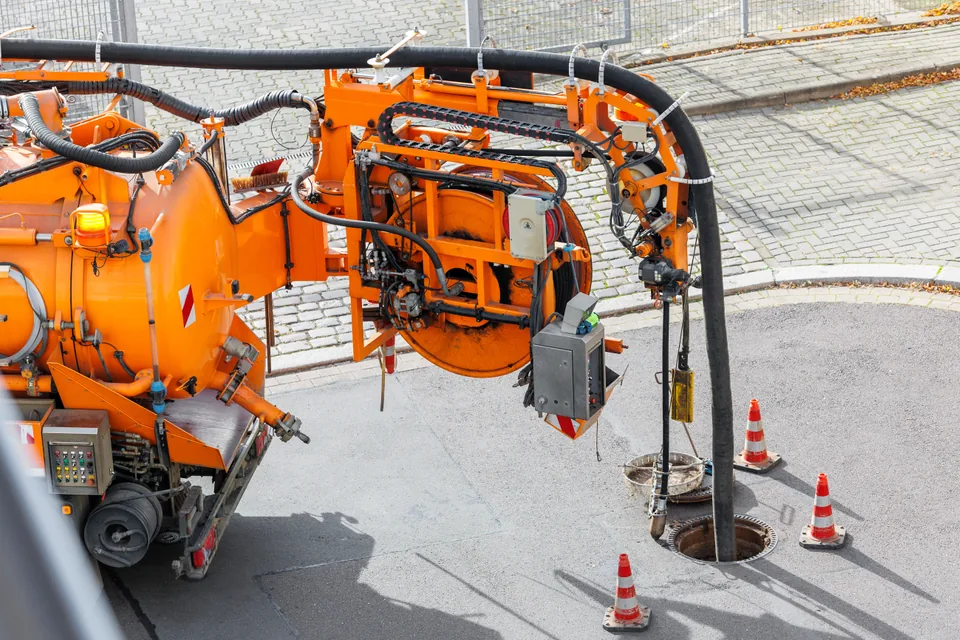
A combination vacuum truck lowering its hose into a street manhole — septic contractor insurance in Ohio

Ohio issues no state septic installer license. There is no state licensing board for this trade to find: the word license does not attach to this trade anywhere in ORC chapter 3718 or OAC chapter 3701-29. The rule titled for designers creates no credential either. What Ohio has instead is a register, issued by your local board of health, and the rule states its own effect in terms — “only persons registered by the board of health as an installer, septage hauler, or service provider shall perform the duties defined in” its three definition paragraphs. The counter is the board of health of the health district where the work is performed.

That counter is not a single errand, because registration is per board of health and per category: installers, septage haulers and service providers register “with the board of health for each category of work prior to performing the duties defined in” those same paragraphs, and “A registration shall not be transferable and shall expire at the end of the calendar year.” A crew that installs, services and pumps holds three registrations in every district it works — one trade in three districts is three registrations, three trades in three districts is nine. Note the noun the statute uses: “Board of health” means “the board of health of a city or general health district”. A general health district is county-based, a city health district is not, and neither of them is the county government, so an Ohio reader sent to a county office has been sent to the wrong counter.

The duty does not reach everyone on the site, and the rule says who it leaves out rather than leaving that to inference. The supervised employee is outside it: “Registration is not required of any person who performs labor or services as an employee under the direct supervision of a registered contractor.” Two trades are outside it — the rule exempts subcontractors who perform electrical or plumbing work under contract for a registered installer, septage hauler or service provider. And one class of property is outside it: the owner of a licensed campground who collects and transports domestic septage within the campground premises, on conditions the rule states, among them that the septage is not transported across or on a public roadway and that the equipment is designed and maintained to prevent spills and is available for inspection by the board of health. What those three carve-outs do not do is soften anything for the contractor who holds the work: the rule puts three classes outside the registration duty, and the operator who signs the contract is not one of them.

One component of the credential is statewide, and it is the financial one. The statute directs that “The rules shall establish uniform statewide bonding requirements or other financial security requirements for installers, service providers, and septage haulers as a condition of registration within any health district.” It also forbids a board of health to require a different or additional bond on top. So the bond or approved financial assurance travels; the registration does not. The same rule also names a liability limit — “Proof of no less than five hundred thousand dollars general liability insurance coverage.” at OAC 3701-29-03(C)(4) — and provides that where a contractor holds several of the three registrations, that coverage answers for the multiple categories. It is proof a board of health checks as a condition of registration: a regulatory floor, not a recommendation. The bond amount moves with the category and with how many systems the contractor does in a year, which is a table in the rule rather than a number that belongs in a sentence.

The last structural fact is the local-stringency direction: in Ohio it is a floor, not a ceiling, and a board of health may be more stringent than the state rule. Subject to the director’s review and approval, “a board of health may adopt rules necessary for the public health providing for more stringent standards than those established in rules adopted by the director under division (A) of this section”. That means a detail compliant under the state rule can lawfully fail in the next district over. Ohio also credentials nobody for two of the judgments on the job — it has no designer credential and no septic inspector certification of any kind — while ORC 3718.02(A)(6) requires a board of health to “inspect a sewage treatment system not later than twelve months after its installation to ensure that the system is operating properly.” Each absence is an exposure rather than a convenience: the design exposure commonly sits on the registered installer who builds the system, and a public body re-inspects the finished work inside a year.

Almost none of that is an insurance requirement; the general liability proof on the registration is the rare case where licensing and coverage meet in one clause. Everywhere else the credential question and the coverage question are separate, and the sections below set out each one with the authority it rests on, so you can check it rather than take our word for it.

What Ohio requires of a septic business

Installing

Ohio has NO state-issued septic installer license. What Ohio has is a STATEWIDE MANDATE discharged at a LOCAL COUNTER: the director of health’s rules require every board of health to register installers, service providers and septage haulers working in its district, and the registration is per district, per category, and expires at the end of the calendar year. None of that leaves an Ohio installer free of any duty: the duty is real, statewide, bonded and insured.

Authority ORC 3718.02(A)(8); ORC 3718.01(C), (D), (F), (I), (N), (O), (Q), (R); ORC 3718.02(A)(1), (A)(2), (A)(5), (A)(6), (A)(9), (A)(16); ORC 3718.02(B)(1) and (B)(4); ORC 3718.05(C); ORC 3718.07; ORC 3718.08; ORC 3718.021; OAC 3701-29-03(A), (B), (C)(4), (C)(6), (E), (F), (I), (L), (M); OAC 3701-29-01(FFF), (JJJJ), (OOOO); OAC 3701-29-10(A); OAC 3701-29-22(A) and (C) — read the source

Pumping and hauling

Ohio’s septage credential is NOT a separate agency’s permit. It is the THIRD CATEGORY on the same board of health register that carries the installer, created by the same statutory subsection and the same rule — and then it carries two things the other two categories do not: a permit for EACH VEHICLE, and a separate site permit before septage may be land applied. Several states put the pumper under an environmental agency. Ohio does not.

Authority ORC 3718.02(A)(8); ORC 3718.02(A)(9); ORC 3718.02(A)(16); ORC 3718.01(D) and (N); OAC 3701-29-03(A), (B), (C)(3)(c), (C)(5)(b), (C)(6), (I)(1), (I)(2), (I)(3), (I)(4), (I)(5), (M); OAC 3701-29-01(JJJJ); OAC 3701-29-20(A), (B)(1), (B)(2), (C), (D)(7), (E), (E)(1), (E)(2) — read the source

Inspecting and evaluating

Ohio certifies NO septic inspector, at the state level or at any other level. It does not have an inspector credential at all: the word does not appear in its sewage statute. What Ohio has instead is the inspection WORK split across three holders — the board of health itself, the registered service provider, and the registered septage hauler — and only the last two are credentials a contractor can hold.

Ohio regulates the inspection work instead of the inspector: the board of health must inspect a newly installed system within twelve months, paid work evaluating a system falls inside the registered service provider category, and a registered septage hauler may evaluate and report on the condition of a tank it is pumping.

read the source

Workers compensation

Ohio requires every private employer to pay into the state insurance fund the premium the administrator of workers’ compensation fixes for that employer’s occupation, and Ohio’s own statute then closes the private route behind it: "All contracts and agreements are void which undertake to indemnify or insure an employer against loss or liability for the payment of compensation to workers or their dependents" for injury, death or occupational disease in the course of employment, and "No license or authority to enter into any such agreements or issue any such policies of insurance shall be granted or issued by any public authority in this state." An employer of sufficient financial ability may instead apply to pay compensation directly and be granted status as a self-insuring employer. A private workers compensation policy sold to an Ohio employer is not merely unavailable: the contract is void by statute, and no public authority in Ohio may license anyone to write it.

Authority ORC 4123.35(A) and (B); ORC 4123.82(A) and (B)(1); ORC 4123.01(A)(1), (A)(2)(a)-(f), (B)(1)(a) and (B)(1)(b); ORC 4123.15(A) — read the source

What Ohio requires of a septic business — installing, hauling, inspecting and workers’ comp through the state fund — and what each requirement leaves to the insurance program.

A panel for Ohio in rows. Each row sets one thing the state requires beside the exposure that requirement leaves open and the coverage line that answers it. Installing: No state installer license; the board of health registers installers. It leaves open a failed install or drainfield, damage to the customer’s property, which General Liability and Pollution Liability answer. Pumping and hauling: A septage hauling permit is on the books. It leaves open a spill or release in transit, the truck at fault, which Commercial Auto and Pollution Liability answer. Inspecting and evaluating: No statewide inspector or evaluator certification; it varies locally. It leaves open a missed defect in an inspection or design, which Professional Liability answers. Workers compensation: Compulsory; placed only through the state fund. No connector is drawn for this row. Notes: A license, permit or bond is not a policy — a bond secures the public body that requires it, not the customer. Workers’ comp is placed through the state fund, so no connector is drawn to that line. The conclusion reads: The credential is not the coverage — the program is. No figures are shown.

Where we write in Ohio

Columbus · Franklin County

New-construction-driven work means the septic contractor is one trade inside a general contractor’s sequence, which is where additional-insured and contractual-liability questions arrive on this account — and in Ohio it arrives beside ORC 4123.01(A)(1), which makes an uninsured subcontractor’s injured worker the general contractor’s own employee.

Cleveland · Cuyahoga County

A registration that lapses in one district while the others stay current means the same crew is registered on Monday and unregistered on Tuesday without changing anything about its competence — and OAC 3701-29-03(A) makes performing the duties without registration the violation. Multi-district exposure is a lapse exposure, and calendar-year expiry under (B) puts every district’s renewal on the same date.

Toledo · Lucas County

A drainage-dependent design puts part of the system’s performance outside the absorption field the contractor actually built, so a failure argument turns on whose work the water was — the classic completed-operations dispute on this trade, and here it is written into the design standard.

Dayton · Montgomery County

A septage land application site permit is issued by a board of health under OAC 3701-29-20(E) and the board may prohibit, restrict or limit land application in its jurisdiction altogether under (A) — so a hauler’s disposal route can close by rule without anything happening to the hauler. That is a business-interruption-shaped exposure that no vehicle schedule describes.

Akron · Summit County

A design that satisfies the statewide rule can be non-compliant one district over, lawfully, under ORC 3718.02(B)(1). A contractor carrying one standard detail across a district line is carrying a rework exposure, and rework on an absorption field is an excavation rather than a service call.

Athens · Athens County

Variance work is bespoke design work, and Ohio puts no credential behind the designer at all (OAC 3701-29-10(A)). On this ground the design judgment and the installation judgment routinely sit on the same registered installer, which is where a professional exposure and a completed-operations exposure stop being separable.

Chardon · Geauga County

Three published registers is the three-category structure of OAC 3701-29-03(B) made visible: a crew that installs, services and pumps is three registrations and three bond obligations in this one district, and the same three again in the next one.

Marietta · Washington County

An operator working both banks is carrying credentials under two states' regimes and two workers compensation structures, only one of which this record verifies.

Ohio questions we get asked

Does Ohio license septic installers?

No. Ohio issues no state septic installer license, and there is no state licensing board for this trade to find. The credential an Ohio installer actually holds is a registration, issued by your local board of health — the board of health of the health district where the work is performed. The rule puts its own effect plainly: “only persons registered by the board of health as an installer, septage hauler, or service provider shall perform the duties defined in” its three definition paragraphs.

How many registrations does one crew need?

One registration per district per category, so the count is a multiplier. Installer, service provider and septage hauler are three separate categories on one register, and the rule requires registration “with the board of health for each category of work prior to performing the duties defined in” those definition paragraphs, adding that “A registration shall not be transferable and shall expire at the end of the calendar year.” A crew that installs, services and pumps across three districts is carrying nine of them, all falling due on the same date.

Is anyone exempt from registering?

Yes, and the rule names them rather than leaving it to inference. “Registration is not required of any person who performs labor or services as an employee under the direct supervision of a registered contractor.” Subcontractors performing electrical or plumbing work under contract for a registered installer, septage hauler or service provider are exempted as well, and so is the owner of a licensed campground collecting and transporting domestic septage within the campground premises, on the conditions the rule sets. None of the three reaches the contractor who holds the work.

Does Ohio tell me what insurance to carry?

On the licensing side it does, which is unusual. Registration is conditioned on “Proof of no less than five hundred thousand dollars general liability insurance coverage.” at OAC 3701-29-03(C)(4), and the same paragraph provides that where a contractor holds several of the three registrations, that coverage answers for the multiple categories. A surety bond or other approved financial assurance is a separate condition. The board of health checks that proof as a condition of registration; it is a floor, not a recommendation.

Can my health district be stricter than the state rule?

Yes: in Ohio the local layer is a floor, not a ceiling. Subject to the director’s review and approval, “a board of health may adopt rules necessary for the public health providing for more stringent standards than those established in rules adopted by the director under division (A) of this section”, and the board must consider and document the economic impact on property owners in the district. The same standard detail can be compliant in one district and not in the next one over.

Do I need workers compensation, and can I buy it privately?

Yes, from the first employee. Ohio sets no headcount floor — the duty attaches to an employer that “has in service one or more employees or shared employees regularly in the same business or in or about the same establishment under any contract of hire”, at ORC 4123.01(B)(1)(b). Every private employer pays its premium into the state insurance fund unless granted status as a self-insuring employer. The private route is closed: the voiding statute is set out word for word in the workers compensation section above, and it means a private policy sold to an Ohio employer is void, not merely unavailable. And a contractor whose septic sub has failed to pay into the state insurance fund can find the sub’s injured worker treated as its own employee, which is why proof of coverage gets asked for on this trade here.

This page reports Ohio law as our own state research file records it. It is general information rather than legal advice, and it is not an opinion on what any policy covers — the wording you hold controls that, and carriers do not all write it the same way.

Talk it through with someone who reads the forms

Tell us what you install, what you pump and who is on the crew, and we will read the forms against the work.

Get a quote