Missouri’s installer duty has exactly one deliberate gap, and it is drawn around a class of
owner. The rule states the duty and its exception in a single sentence: at 19 CSR 20-3.080(4)
an individual must be registered with the department to install an OWTS “with the exception of
a homeowner meeting the requirements of section 701.055, RSMo”. That section lets property
owners install, modify or repair “their own on-site sewage disposal system” as long as they
comply with the rest of the chapter, and a second owner limb at 701.055.2 RSMo does the same
for an owner cleaning their own system. The carve-out is about ownership and use, never skill
or scale. It reaches the owner working on the owner’s own system; a landlord’s rental, a
builder’s spec house and a friend with a backhoe all sit outside it. A contractor working on a
customer’s property is not the person the exception describes.
For everyone else the operative words are the statute’s own. 701.031 RSMo provides that “Any
person installing on-site sewage disposal systems shall be registered to do so by the
department of health and senior services”, and the rule grades that registration into a basic
class and an advanced class, with only advanced registrants permitted to install the systems
the department lists as advanced. The department is not the only body that grants it. Under
701.053.1 RSMo a county that has adopted the contractor registration program by order or
ordinance may register installers as well. The statute then deems the county grant a state
registration: “A registration issued by a county in compliance with sections 701.053 to
701.055 shall be considered a state registration and valid in all political subdivisions of the
state.” None of that is the permit for a job. 701.046 RSMo makes the construction permit its
own step, applied for with the city, county or department for the site before construction or
a major modification or major repair begins. The registration is the person’s; the permit is
the job’s; the two can come from different counters, and a county may hold the work to a
standard stricter than the state floor under 701.047 RSMo.
The statute also says two things about this program at once, and this page does not pick
one. 701.040(3) RSMo, recently amended, still directs the department to develop “a voluntary
registration program for on-site sewage disposal system contractors”, while 701.031 RSMo and
19 CSR 20-3.080(4) both state the duty in mandatory words. Both texts are in force today. The
penalty sections show where the weight falls: 701.057.3 RSMo makes a violation of 701.031 an
infraction, rising to a class C misdemeanor for a persistent violation after notification,
while 701.057.1 RSMo makes a violation of 701.053 — holding yourself out as registered when
you are not — a class A misdemeanor. So Missouri treats falsely claiming the registration more
severely than installing without one.
Three provisions decide how a registered crew actually runs. The registration is held by an
individual, and 19 CSR 20-3.080(9)(B) requires that registered installer to “Be present at
the construction site during construction and supervise all construction activities”. The
definition of the reached person includes “excavating or earthmoving work connected with the
construction of an OWTS on behalf of, or under contract with, the property owner”, so the excavation
subcontractor stands inside the definition rather than beside it. And the registration runs
on a fixed clock: under 19 CSR 20-3.080(7) it expires thirty-six months from its effective
date, continuing education has to fall inside that same window, and a renewal application that
arrives more than forty-five calendar days after expiry is not accepted — the individual goes
back through the initial registration process, training included. A few days late is a late
charge; seven weeks late is starting over.
Design is spread across other credentials. Missouri has no separate septic designer
credential: where percolation tests are slower than sixty minutes per inch, 19 CSR
20-3.060(2)(D) requires the design to be drafted and signed by a registered engineer unless a
soil evaluation determined site suitability and sizing, and 19 CSR 20-3.080(3) makes any part
of a percolation test or soil morphology evaluation its own registration. A Missouri septic
firm that does its own soil work therefore holds two registrations, not one with an
endorsement.
The bond is the Missouri fact most often stated wrongly, so here it is in full. 701.052.1 RSMo
reaches a person who has, within the preceding twenty-four months, been found guilty of or
pleaded guilty to a violation of the permit and inspection sections, and says that person “may
not begin construction, major modification or major repair of an on-site sewage disposal
system that is owned by another person” unless a performance bond or letter of credit has been
provided to the department. 701.052.2 RSMo sets the amount at five thousand dollars, and
701.052.6 RSMo ends the requirement after two consecutive years without a further finding of
guilt. That is a re-entry condition after a compliance failure, with a fixed statutory amount
and a two-year runway — not a condition a Missouri contractor with a clean record is asked to
meet. The registration itself carries no insurance condition and no unconditional bond: across
all 23 published sections of the on-site block of Chapter 701, «insur», «liabilit» and «surety»
occur zero times, and every «bond» sits in 701.052. That sweep covers the statute only. It
says nothing about a county ordinance, because none was read for this page.
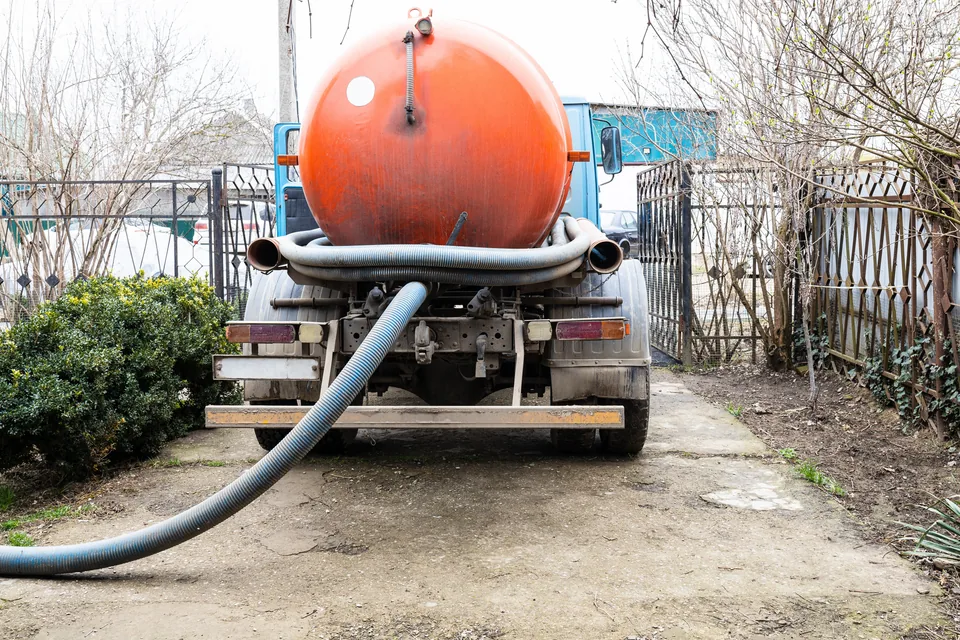
Pumping belongs to a different agency under a different law, and the answer turns on where
the load goes. The on-site chapter creates no pumper or hauler credential at all. The
Department of Natural Resources administers the operating permit that reaches land
application, under 644.051.2 RSMo and 10 CSR 20-6.015(2)(A), and 10 CSR 20-6.015(3)(B)13.
releases a contract hauler from it only “if all waste is hauled to a facility permitted under
a Missouri state operating permit or Missouri Solid Waste Management Law and regulations”.
All waste, not most: one afternoon of land application turns an exempt operation into one that
needed a permit it does not hold. The health department’s holding-tank rule then reaches across
agencies — 19 CSR 20-3.060(6)(F)6. has the owner keep a disposal contract with a pumper or firm
that “possesses a current and valid permit issued by the Department of Natural Resources for
such activity” — so a customer’s compliance can hang on the hauler’s paperwork.
Inspection is where Missouri switches words. The evaluator of an existing system for a real
estate transaction is licensed, not registered, under 19 CSR 20-3.070, and 19 CSR
20-3.070(7)(A) says “The license shall be issued to only one (1) individual person and not to
a company, firm, association, or other group.” It is not transferable, so a Missouri septic
business sells the service while a named employee holds the credential — and if that person
leaves, the service goes with them. The closing band is strict: “No person without a valid
license may conduct any part of an inspection or evaluation of an OWTS, whether on his/her own
or under supervision of a person with a valid license.” 19 CSR 20-3.070(11) lets the
department audit a licensee’s work by an unannounced visit to the property, and 19 CSR
20-3.070(12) counts directing or allowing an unlicensed individual to do any part of the work
among the grounds for discipline, so a firm can lose its licensee over what a helper did. The
license does not reach construction inspection or complaint investigation, and state law does
not make the evaluation compulsory before a sale — though a lender, a buyer or a county may.
Failing to insure costs an employer more than a fine: under 287.280.1 RSMo the injured worker may elect to sue the employer for damages, and
in that action it is no defense that a fellow servant was negligent, that the employee assumed
the risk, or that the employee was negligent to any degree. 287.128 RSMo separately makes a
knowing failure to insure a class A misdemeanor, with a penalty on top, and a repeat offense a
class E felony. The market has also changed shape: the state-created insurer was converted to a
private mutual insurance corporation under 287.921 RSMo, and what remains for an employer who
cannot place coverage through ordinary methods is the residual plan at 287.896.2 RSMo — an
apportionment among private insurers, not a state fund. The one exit an owner might reach is
tiny: 287.090.5 RSMo lets a corporation withdraw from the chapter only “when there are no more
than two owners of the corporation who are also the only employees of the corporation”, so it
removes nobody once a third person is hired and is not an opt-out for a contractor with a crew.
Put together, the conditional bond is the only instrument in Missouri’s on-site chapter that
reaches a contractor’s balance sheet at all, and it reaches only a contractor with a recent
conviction.
Everything else is a registration, a license, a permit or a routing rule, and the
insurance question follows from how each can lapse or be exceeded. The markets below pair a
statewide provision with a place where it does visible work; every provision is statewide, and
the place is context.