
Coverage line
Professional Liability
The part of the job that ends with your name on a report, a design or a soil evaluation — and the coverage written around it.
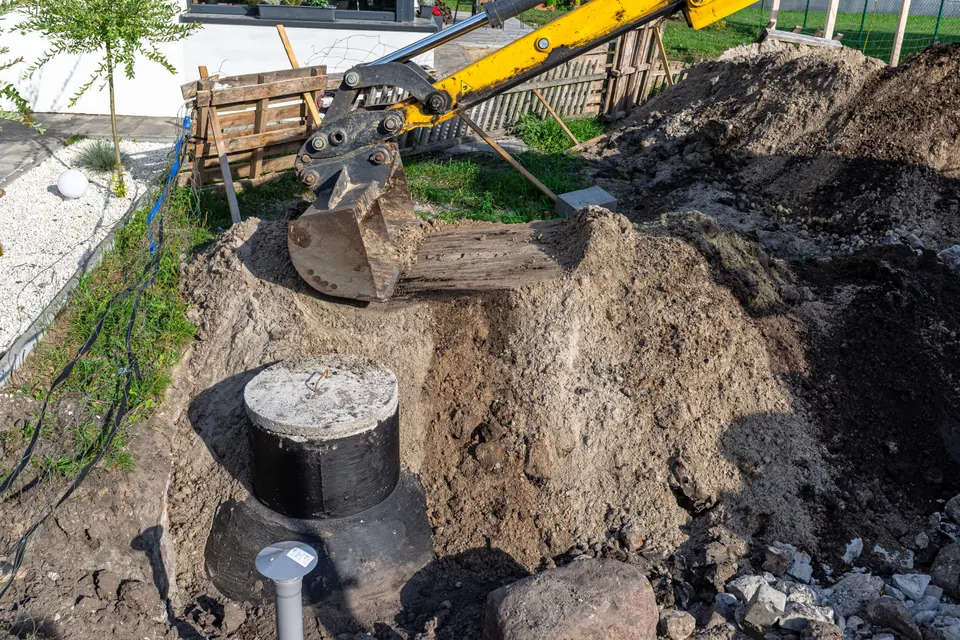

Professional liability — errors and omissions coverage — is the line written for the part of a septic job that produces a document instead of a trench: an inspection report, a system design, a soil evaluation, a certification somebody else acts on. It is generally built to answer money a third party loses through an error, a mistake or negligence in delivering a professional service, rather than injury or damage caused by the physical work. For a contractor who installs, pumps and repairs, one question sorts it: which jobs leave the customer holding your opinion?
When the job hands over a document instead of a trench
You dig, you set tanks, you pump, you chase a failing drainfield. On some jobs, though, what the customer receives is a signature. One state’s statute names inspector, installer, designer, service provider and maintainer as separate professionals, and the same licensed business may inspect a property and then design and install a new system for it. That is the ordinary shape of this trade: one business wearing several hats, only some of which end in paper.
Errors and omissions coverage is the line built around the paper. The way it is usually defined, it answers an “error or omission in performance of professional duties”, and policies of that family are generally written to respond to financial loss rather than to bodily injury or property damage — the trigger being an error, a mistake or negligence in delivering a professional service.
None of that makes inspection a separate trade. This page is about a septic contractor whose week sometimes ends with a report rather than a backfilled trench.
Designing a system you may also be the one to build
Federal guidance is blunt that system type and size vary widely for site-specific reasons — household size, soil type, site slope, lot size. Design is a judgment about a particular piece of ground, not a catalog selection, and one state’s statutory definition of a designer is a person who “investigates soils and site characteristics” to determine suitability and who then designs the system.
The same guidance asks the designer to identify the significant design boundaries at the receiving site, and treats construction oversight as work for an approved licensed or certified inspector — preferably the person who designed the system. It names designers, site evaluators, installers and inspectors as distinct trained roles even where one business fills several.
When a design turns out to be wrong, the loss is rarely a cut hand or a broken slab. It is that the system has to be moved, rebuilt or permitted again — money, traceable to a judgment rather than a shovel.
Soil evaluation, perc tests and the judgment inside a loading rate
The percolation test was developed to give an estimate of the soil’s saturated hydraulic conductivity, and an empirical factor was applied to that result to turn it into a design rate. Federal guidance records that the method has many flaws, that many programs regulating onsite systems moved away from it, and that many states no longer accept it as the primary criterion — soil texture and structure correlate better with the infiltration rate, and many agencies now ask for a soil profile by a soil scientist or a certified site evaluator.
That guidance is direct about what the work demands: substantial knowledge of soils, soil morphology and geology is essential, and the “site evaluation must be sufficiently thorough” to find every design boundary on the site — a sequence that begins with a preliminary review of documented site information.
Notice where that ends. The evaluator suggests loading rates, flags design considerations and relays them to the designer and the applicant, and the documentation is relied on by other site evaluators, designers, regulators and contractors. A soil evaluation is not a test you file; it is an opinion other people build on.
The report a buyer or a lender ends up leaning on
Point-of-sale inspection is where this exposure gets crowded. Federal guidance records that several states and counties require sellers to disclose or verify system performance, that at least one state mandates inspection at property transfer, change of use or increased flow and allows those inspections only by approved persons, and that transfer inspections are common even without any regulatory requirement. Where a lender drives the inspection rather than a rule, that guidance notes such inspectors might not carry the same accountability.
The pressure is not only regulatory. A state appeals court held (2021) that a seller’s disclosure form is not a substitute for a buyer’s own inspection, that buyers are charged with knowledge of the conditions a reasonable inspection would have disclosed, and that transferees are encouraged to obtain a professional inspection. That moves weight onto whoever performed the inspection.
A state trial court held (2014) in a dispute that reads like a septic contractor’s bad dream. A firm hired to certify that an on-site mound sewage disposal system met state permit requirements later reported that it had completed the original inspection; buyers alleged it gave out information it knew was wrong and that a later buyer would act on, and negligently failed to determine that the system had not been constructed as designed. The question was framed as whether a duty ran from the certifying firm to a later purchaser.
The rule that court worked from sits behind most of these claims: a person who supplies false information for the guidance of others may be liable for pecuniary loss caused by their justifiable reliance on it if he did not use reasonable care or skill in gathering or passing it along, and it reaches only the limited group he intended to inform. The economic loss rule generally bars tort recovery for purely economic losses, with negligent misrepresentation cited as an exception — and a treatise quoted there observes that certifications can create liability beyond their issuer’s own clients.
Certification that lands at the county line as often as the state line
Owners ask what license this work requires, and the honest answer is that the level varies. Federal guidance records that standards and enforcement practices vary widely among the states, that some jurisdictions do not require licensing of installers at all, and that some certify inspectors while others do not.
The layer that touches most jobs is local. An extension service tells applicants to submit the site plan to the county health department, and one state health agency states plainly that local health departments issue the onsite system permits. A page telling you a state license is required to inspect would be wrong across much of the country; one telling you nothing is required would be wrong across the rest.
Ask the health department that issues your permits which certifications attach to design, soil evaluation and inspection work in your area. The underwriting conversation generally starts with what you are certified to sign.
A hub-and-spoke diagram. At the center is the signed opinion, the part of a septic job that hands over a document instead of a trench. One spoke is the system design, which can send the job back, since a wrong design means the system has to be moved, rebuilt or permitted again. One spoke is the soil evaluation and the loading rate inside it, relied on by designers, regulators and other contractors. One spoke is the point-of-sale inspection report, relied on by a buyer or a lender at transfer. One spoke is a certification that a system met its permit, which a later purchaser may say they relied on. The last spoke is construction oversight, work federal guidance prefers the designer to do, where the question is whether the system was built as designed. No figures are shown.
What a professional services clause in a liability form reaches
Most liability forms carry wording that carves professional services out of the grant. One such clause — unnumbered in the record where it appears, and described here only for its shape — stated that the insurance did not apply to bodily injury or property damage caused by rendering or failing to render professional services, and reached services performed by the insured or by an engineer, architect or surveyor employed by the insured or working on the insured’s behalf. Its definition listed preparing or approving reports, surveys, drawings and specifications, and separately listed “Supervisory, inspection, architectural or engineering activities”.
Read that list against a septic contractor’s week and the overlap is obvious. It is also the easiest fact on this page to overstate, so here is the limit of what it shows: wording of this family can reach injury and property damage — not only economic loss — where a professional service caused them. It does not show that any particular septic claim is or is not covered under any particular policy. A federal appeals court held (2025) for the insurer on that clause on those facts, while restating that the insurer bears the burden of proving an exclusion applies.
Treat it as a map of where the line tends to be drawn in wording, not as an adjustment of your claim.
A comparison in two columns. The first column holds the judgment side, which professional liability generally answers: money a third party loses through an error, a mistake or negligence in a professional service; a design that has to be moved, rebuilt or permitted again; and a buyer or lender who relied on an inspection report or a certification. The second column holds the physical-work side, typically general liability’s territory: bodily injury and property damage arising out of the digging, setting, pumping and repair; and faulty construction work, which design-professional coverage normally excludes. Between them, a professional services clause in a liability form can reach injury and damage a professional service caused, and which form answers depends on the exact wording and the exact facts. No figures are shown.
Where this line stops and general liability begins
The axis between the two is not which loss happened but what caused it. Professional liability forms generally cover only “economic or financial losses suffered by third parties”, while claims for bodily injury and property damage arising out of the physical work are typically the general liability policy’s territory. This page owns the judgment side of that line; the physical-work side, and the seam that runs through it for this trade, belongs to our general liability page, and we do not settle it here.
The same axis appears from the other direction in the market written for design professionals: that coverage insures them against errors and omissions in their work and normally excludes faulty construction work. Which form answers a given septic loss depends on the exact wording and the exact facts.
Claims-made dates, defense costs, and the wording that decides
Two structural features matter more to a septic business than any coverage grant. The first is the trigger: the large majority of professional liability policies are written claims-made, responding where the claim is “first made against the insured during the period”, where an occurrence trigger instead applies to incidents occurring while the policy is in force. A report can sit in a file until a drainfield surfaces, so the year you signed and the year the letter arrives are often not the same — which puts continuity across a carrier change in the conversation.
The second is defense economics. On policies of this family, defense spending generally reduces what remains of the limit, where under a general liability policy defense costs are usually paid in addition to limits — different arithmetic behind the same nominal number.
None of it decides your claim, and this page cannot. The wording you actually hold controls, carriers do not all write it alike, and the answer to any real question here depends on the exact wording and the exact facts.
If part of your work ends with your name on a report, a design or a soil evaluation, say so when you ask for terms — it is the piece of a septic business a contractor’s liability form is generally not built around, and it is easier to sort out before a closing than after. Send us what you sign and what you hold, and we will read the forms against the work.
Related coverage for septic business owners
- General Liability
- Pollution Liability
- Workers Compensation
- Commercial Auto
- Contractors Equipment
- Commercial Property
The work we write
Professional Liability questions we get asked
I install and pump for a living. Why would I have a professional liability exposure at all?
Because some jobs end with a document rather than a system. A report, a design, a soil evaluation or a certification is a professional judgment other people act on, and one state’s statute treats inspector, installer, designer, service provider and maintainer as separate professional roles that a single licensed business may hold at once. If none of your work produces a signed opinion, this line has less to answer; if some of it does, that is the exposure.
A buyer says my inspection report missed something and wants the system replaced. Which policy would that go to?
That depends on the exact wording you hold and the exact facts, and we will not tell you on a web page that it is or is not covered. The general shape is that professional liability forms are written around third-party economic loss from an error or omission in professional work, while injury and property damage from the physical work are typically the general liability policy’s job. Send us the claim letter and the forms.
I ran the soil evaluation and somebody else did the design. Can they still come back at me?
Federal guidance describes the evaluator’s documentation as something other evaluators, designers, regulators and contractors rely on, and the evaluator is the one who suggests loading rates and flags design considerations for the designer and the applicant. A written evaluation is therefore a judgment relayed to people who build on it, not a private note, and reliance by someone downstream is the shape most of these disputes take.
My county wants a soil profile instead of a perc test. Does that change my exposure?
It changes what you are representing rather than whether you are representing anything. The percolation test was developed to estimate the soil’s saturated hydraulic conductivity, with an empirical factor converting the result into a design rate; federal guidance records that the method has many flaws, that many programs regulating onsite systems moved away from it, and that soil texture and structure correlate better with infiltration. Either way you are signing an opinion.
Do I need a state license to inspect septic systems?
Frequently it is a county question rather than a state one, and in some jurisdictions there is no installer licensing requirement at all. Federal guidance records that standards and enforcement practices vary widely among the states and that some jurisdictions license or certify inspectors while others do not; permits themselves are often issued by the local health department. Ask the health department that issues your permits, and check our page for your state.
I certified a system a while back and just got a letter about it. Does the year I signed it matter?
On this line it usually matters a great deal. The large majority of professional liability policies are written on a claims-made trigger, which generally responds when the claim is first made against the insured during the policy period, rather than on an occurrence trigger keyed to when the incident happened. Continuity, retroactive dates and what happened when you last switched carriers all belong in that conversation.
Talk it through with someone who reads the forms
Tell us what you install, what you pump and who is on the crew, and we will read the forms against the work.