
Coverage line
Pollution Liability
The separate policy written for the one material this trade moves every day — hedged, because the forms differ and the facts decide.
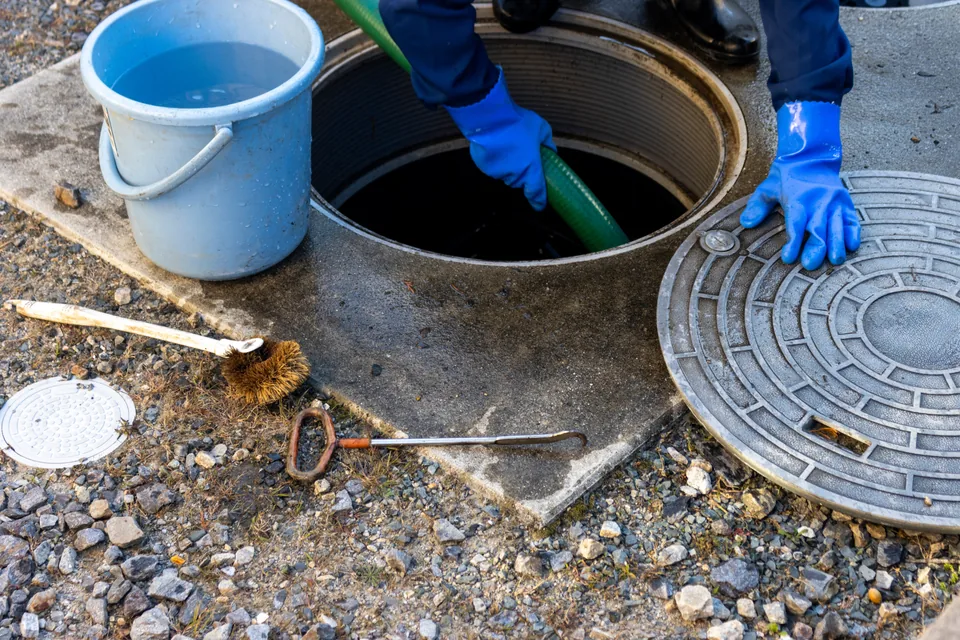

Contractor’s pollution liability is the separate policy written to answer pollution conditions arising out of a septic business’s own work, and on the wordings read for this page the grant generally names bodily injury, property damage and environmental damage together rather than any one of the three. An owner buys it because on this trade the pollutant is the job: sewage, septage and effluent are what the crew moves every day, and the unendorsed liability wording most septic businesses already carry is the wording most likely to argue about exactly that material. What follows is the grant, what turns it on, what it asks of an owner, and where its edges run — hedged throughout, because forms differ between carriers and any single loss turns on the exact facts.
Why the pollutant on this job is the job itself
Federal rule describes domestic septage as material removed from a septic tank, a cesspool or a portable toilet, and the federal on-site manual describes septage as the entire contents of the tank, taking in pumpings from aerobic units, holding tanks and toilets as well. The same manual records that septage may harbor potentially toxic levels of metals and chemicals, and the Clean Water Act names sewage and sewage sludge in its own list of pollutants. None of that decides a claim. It matters because it describes, in the agencies’ own language, the material sitting in a pump truck at the end of an ordinary Tuesday.
Insurance wording arrives at the same place by a different road. On one environmental policy read in litigation, the definition of pollutant expressly reached “medical, infectious or pathological waste or waste materials”, a description a load of septage does not have to strain to meet. That is one wording and not a market, and other forms describe the category differently. But assume the question will be asked, because what the insurer is describing is not an exotic chemical — it is the product.
Where the material goes afterward carries its own exposure. The federal manual records land application as the most commonly used disposal method, notes the pollution risks that come with landfill disposal through runoff and leaching toward groundwater, and discourages disposal of portable toilet waste mixed with disinfectants at land application sites. Each is a place a pollution condition can start without anyone doing anything dramatic.
A two-column comparison. The first column holds harm to others under the pollution grant. Bodily injury from a pollution condition, such as exposure to escaped septage, is one. Property damage to land, structures and water, where effluent reaches a yard, a ditch or a well, is another. Environmental damage is named alongside both on the wordings read for the page, rather than riding on either. The second column holds costs and conditions read as their own promises. Cleanup cost to investigate, contain and remediate is, on one wording, a separately lettered grant needing the insurer’s written consent. A slow seep nobody noticed does not so much fail a timing test as run out a discover-then-report window. And a release at the owner’s own yard, where a job-site grant may not obviously reach, is worth separating before a quote is bound. Forms differ between carriers and any loss turns on the facts. No figures are shown.
Where a contractor’s pollution grant begins
A contractor’s pollution policy quoted at length by a state supreme court (2015) promised to pay sums the insured becomes legally obligated to pay where a pollution condition arising from covered operations caused bodily injury, property damage or environmental damage. Three things in that sentence do the work: it runs to three kinds of harm rather than one, to pollution conditions rather than accidents generally, and to the insured’s own operations rather than to wherever the insured is standing.
That third tie repays a close reading. On the same wording, covered operations meant activities “performed by the Named Insured at a job site”, and the trigger reached conditions that were “unexpected and unintended from the standpoint of the Insured”. Both are thresholds an owner can be measured against: the first asks where the work was done and by whom, the second asks what the business knew, which is usually a harder question than what it intended. On most environmental forms that standpoint language is where a long-running seepage argument lands.
The reach of the grant, on that wording, followed the familiar list: discharge, dispersal, release or escape into or upon land, any structure on land, the atmosphere or any watercourse. That is deliberate. The pollution grant is generally built from the same vocabulary as the exclusion it sits beside, restated as a promise instead of a refusal, and that policy left irritant and contaminant undefined exactly as the exclusion does.
The description to avoid is that this grant is simply the photographic negative of the exclusion, because the same state supreme court (2015) accepted that it is entirely possible for both a general liability policy and a pollution policy to respond to a single loss. Construing an exclusion and construing a grant are separate exercises, and an owner is generally better served asking what each wording turns on than assuming the two meet without a gap or an overlap.
Sudden, accidental, and the test that replaced it
An earlier general liability form preserved coverage for pollution incidents that were sudden and accidental, and for a long stretch that phrase was the whole argument. The litigation turned on whether sudden meant merely unexpected or carried a temporal element — a brief period of time, or something closer to all at once — and the temporal reading is the one that prevailed. It is not live coverage: it belongs to an earlier general liability form, and to a test that litigation narrowed.
What generally sits in that space now is a stated window rather than a test of how fast the release was. One contractor’s policy carried an exclusion captioned as absolute pollution and pollution-related liability, reaching injury tied to a pollution incident directly or indirectly, by relation, or in any way at all. Its only exception was a time-element endorsement conditioning cover on discovery inside a short stated window followed by written reporting inside another. Those windows were one insurer’s own and not an industry rule, so what generally matters is the shape: discover, then report, quickly.
The practical difference is that the old test asked what the release was like and the new one asks what the business did about it. A gradual seep nobody notices does not fail a temporal test so much as run out the clock on a reporting condition — a far more ordinary way to lose an argument, and one of the few parts of this subject an owner controls.
Claims-made timing, retroactive dates and reporting windows
A claims-made wording generally turns on arrival: the demand must reach the insured inside the policy period, whenever the underlying act occurred. An occurrence wording generally looks instead to when the injury or damage took place, whenever the claims arrive. Most general liability insurance is written on an occurrence form, which is why the trigger question rarely comes up until an owner buys something else. Do not take from this page that pollution cover is always written one way: two wordings are not a market. Ask.
Where a claims-made trigger is in use, two features usually travel with it. A retroactive date generally eliminates coverage for claims produced by acts that took place before a specified date, and also shuts out claims arising from events far in the past. An extended reporting period runs the other way: one environmental policy read in litigation carried an automatic extended reporting period after expiry, giving a stated run of time in which a late claim could still be brought in. For a trade whose work is buried and whose failures announce themselves years later, both deserve a direct question at quoting time.
Notice is the condition that bites. A federal district court (2020) had before it a contractor who conceded it had not followed the written reporting requirement in its endorsement despite having telephoned, and treated timely notice on a claims-made wording as something that helps define the limits of the insurer’s obligation rather than a courtesy attached to it. That is not a prediction about any particular claim. It is a reason to put the call in writing the same day.
Cleanup cost is a grant of its own
The single most misleading sentence available on this subject is that cleanup is included. On one environmental policy read by a state appeals court (2022), site pollution liability was split into separately lettered coverages, and the first of them — on-site cleanup cost — stood alone rather than riding on the bodily injury grant. It had its own conditions and its own exclusions, which addressed bodily injury, property damage and cleanup costs together.
That wording defined cleanup cost as reasonable and necessary expense to “investigate, abate, contain, treat, remove, remediate, monitor” and otherwise deal with contaminated air, soil and surface water, incurred with the insurer’s written consent. The trigger sat behind a further threshold: a pollution incident meant the discharge, emission, seepage, migration, dispersal, release or escape of a pollutant, provided it was “not naturally present in the environment” in the amount or concentration in question. That qualifier is not academic here, because much of the argument about a failed system is an argument about what was already in the soil.
The duties attached to that grant are where an owner meets it in practice. The insured had to report the incident to the appropriate governmental authority as required by environmental law, mitigate and clean up by retaining an environmental professional, and submit work plans, bids and contracts subject to the insurer’s right of prior approval; a notice of possible claim asked for the identity of anticipated or potential claimants. That was one policy and none of it generalizes, so read the conditions actually on offer. What travels is structural: cleanup and injury are worth reading as separate promises until a document says otherwise.
The ground under your own yard
A septic and sewer service company once sought approval for a truck dispatching and maintenance facility, and a state environmental court (2000) spent its attention on details an owner would recognize. A full truck kept overnight was to be parked in the garage over an existing maintenance pit, and the record acknowledged the pit would hold the contents of a leaking pump truck but not those of the tractor-trailer. Paving sloped wash water toward on-site retention ponds, and the decision weighed what would follow if septage reached the percolation ponds.
Two more details are worth an owner’s attention. Drainage swales on the property had become blocked with silt over a period of years and had to be restored so runoff would be absorbed and treated before reaching groundwater — a slow degradation nobody decided on. And the conditions required the immediate availability of lime to treat spilled residue, to the point that without it no truck containing septage could be stored on site. The yard was regulated as a pollution site in its own right.
Insurance follows that geography imperfectly. A pollution wording tied to operations performed at a job site is not obviously one that reaches the pad where your trucks are washed, fueled and parked, and the two are worth separating before a quote is bound. Much of this work is already tracked: septage management programs commonly use tracking or manifest systems that identify sources and haulers, and set procedures for controlling human exposure. The paper trail that satisfies a regulator is frequently the one an insurer asks for after a release.
A hub-and-spoke diagram read from the pollution policy’s side. At the center is the contractor’s pollution grant at its edges. The liability form’s pollution exclusion is what the grant picks up: general, auto and umbrella forms normally exclude pollution to some degree, which is why a separate policy is sought. Both policies can respond to a single loss, so the grant is not simply the negative of the exclusion; construing a grant and construing an exclusion are separate exercises. The auto form’s in-transit exclusion reaches pollutants carried or in the course of transit, and whether a loaded tanker is an auto question, a pollution question or both is left undecided for septage. A federal restitution endorsement required of certain regulated motor carriers works on reimbursement, not as insurance. And a grant tied to operations at a job site may not reach the pad where the trucks are washed, fueled and parked. Each turns on the exact wording in force. No figures are shown.
Two boundaries this page points at rather than settles
The first boundary is the one this brand exists to explain. Pollution liability is normally excluded to some degree by general, auto and umbrella liability policies, and insurers tightened that wording over time, making it necessary for insureds to seek cover under separate policies. A federal appeals court (2023) read an exclusion of that kind as unambiguous as written. The argument is not hypothetical for this trade: a federal appeals court (2024) heard a bodily injury claim from a sewage backup in which the insurer relied on a pollution exclusion and, separately, on a fungi-or-bacteria exclusion aimed at the same injury. Where a liability form stops for a septic business is argued on our general liability page, not restated here.
The second boundary is the road. A standard unendorsed commercial auto policy generally contains its own pollution exclusion, and a broadening endorsement typically modifies that exclusion without deleting it. On one such wording the exclusion reached pollutants contained in property being transported and pollutants “in the course of transit”, with a separate exclusion for property in the insured’s care, custody or control. Certain regulated motor carriers must also carry a federally mandated environmental restitution endorsement that does not actually provide insurance except on a reimbursement basis: the insurer pays and may then seek reimbursement from the insured.
Whether a loaded tanker on a soft shoulder is an auto question, a pollution question or both is not decided here, and no source read for this page decides it for septage. Our commercial auto page carries the driving side. The advice worth giving is that the two wordings be read against each other before a truck leaves the yard loaded, not after.
What the wording decides, and what it does not
Every sentence above describes documents, not your documents. The forms in use differ between carriers, and the outcome of any particular loss depends on the exact language in force and on the exact facts. Your own policy wording controls. Where this page says a form can read a certain way, it means a form has been read that way — not that yours will.
What an owner can do with all of it is narrow and useful. Find out whether the pollution wording on offer is triggered by a claim or by an occurrence, and what its retroactive date is. Find out whether cleanup is its own grant or a passenger on someone else’s. Find out how long you have to discover and report, and whether the wording reaches your yard as well as your job sites. Those four are answerable in advance, and they are the ones that tend to be unanswerable afterward.
We are an agency, not an insurer: we place cover and read forms against the work, and we do not adjust claims or decide them. If you want someone to read your current wording alongside a pollution quote and mark where the two do not meet, that is a conversation rather than a web page. Tell us what you install, what you pump and who is on the crew, and we will start there.
Related coverage for septic business owners
- General Liability
- Workers Compensation
- Commercial Auto
- Contractors Equipment
- Commercial Property
- Professional Liability
The work we write
- Septic Installation Insurance
- Septic Pumping & Cleaning Insurance
- Septic Repair & Maintenance Insurance
- All services
From the blog
- Septic Services Insurance: What Pumpers, Installers, and Haulers Actually Need to Carry
- Contractors Pollution Liability vs Site Pollution Liability
- Does Umbrella Insurance Cover Pollution for Septic Work?
- Pollution Exclusion Exceptions a Septic Contractor Can’t Use
- Tail Coverage vs Nose Coverage When a Septic Business Sells
Primary sources
- EPA — Resolving Septic System Malfunctions — the federal list of failure signs, including what shows up in nearby water
Pollution Liability questions we get asked
Is a pollution policy claims-made, and what does that mean for jobs I finished years ago?
Sometimes, and it is worth asking outright rather than assuming. A claims-made wording generally responds when the claim is made during the policy period, whoever performed the work and whenever it was performed, while an occurrence wording generally looks to when the injury or damage happened. Most general liability insurance is written on an occurrence form, so an owner who has only ever bought liability cover may reasonably expect the same trigger here and not get it. Ask which trigger a quote is on before you compare it to anything.
What is a retroactive date and why does my pollution quote have one?
A retroactive date generally eliminates coverage for claims produced by acts that took place before a stated date, and it also shuts out claims arising from events far in the past. For a septic business that matters more than it does for most trades, because the work sits in the ground for a long time before anyone knows whether it failed. If you move markets, ask what the new retroactive date does to systems you installed under the old policy.
Does a pollution policy pay to clean the ground up, or only to defend the lawsuit?
It depends on the exact wording, and cleanup is not safe to assume as part of an injury grant. On one environmental policy read in litigation, site pollution liability was split into separately lettered coverages and on-site cleanup cost stood alone as its own grant, with its own exclusions, its own reporting duties and a requirement that the expense be incurred with the insurer’s written consent. That was one policy and not a market, so read the grant structure of the wording actually being offered to you.
How fast do I have to report it if effluent gets loose on a job?
Faster than feels necessary, and in writing. One contractor’s policy restored a narrow slice of pollution cover only where the condition was discovered inside a short stated window and then reported in writing inside another one, and a federal appeals court (2020) recorded the insured conceding it had not followed the written requirement even though it had telephoned. On a claims-made wording, notice conditions of that kind generally help define the limits of the obligation the insurer took on rather than sitting beside it as a formality.
Does pollution cover follow the septage once it is in the truck?
That question does not get settled on this page, and an owner should be wary of anyone who settles it quickly. A standard unendorsed commercial auto policy generally carries its own pollution exclusion, a broadening endorsement usually modifies that exclusion without deleting it, and which wording answers a loaded tanker depends on the exact forms in force and on how the release happened. Our commercial auto page carries that side of it, and the honest answer is that the two policies should be read together before the truck rolls.
What about a spill that starts at my own yard instead of on a customer’s job?
Treat the yard as its own exposure rather than an extension of the job site. At least one contractor’s pollution wording tied its trigger to operations performed at a job site, which is not obviously the same place as the pad your trucks are washed and parked on, and a state environmental court (2000) that reviewed a septic and sewer company’s dispatch yard spent its attention on containment pits, wash water, retention ponds and silted drainage swales. Ask directly whether the wording reaches your own premises and, if it does not, what would.
Talk it through with someone who reads the forms
Tell us what you install, what you pump and who is on the crew, and we will read the forms against the work.