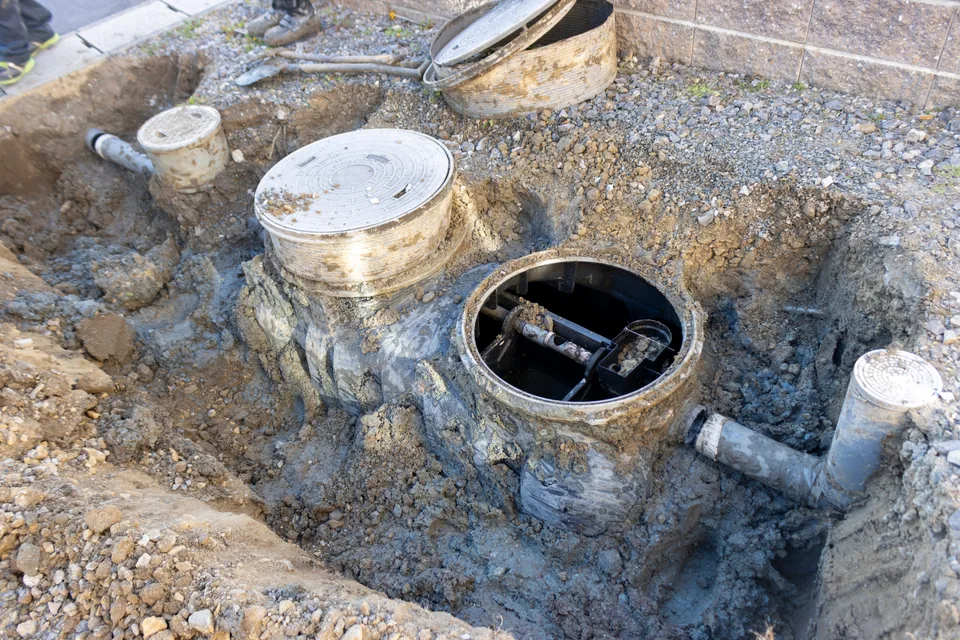
Nevada requires a state contractor license to install an individual sewage disposal system,
issued by the state in a classification that covers this work — and the board that issues it is
a contractor licensing board, not a health agency. Two classifications reach the trade. The
specialty license at NAC 624.440 is the narrow one, granted in the specialty of individual
sewerage, whose holder is authorized to “lay and install individual systems for sewage
disposal”. The subclassification at NAC 624.150(15), inside the general-engineering branch, is
the wide one, covering sewer and drain pipe laying as well as “fabrication and erection of
cesspools and septic tanks”; both provisions are set out in full below. A Nevada septic
contractor may hold either, so anyone who tells you there is one correct license code is wrong
about half the trade. The second thing to know is that the system needs its own approval from
the administrative authority before construction, and the contractor license does not
substitute for it.
The prohibition is expressly bounded by the statute’s own proviso, and this page states that
scope rather than widening it or leaving it out. NRS 624.700(1) makes it
unlawful to “Engage in the business or act in the capacity of a contractor within this State”
“without having an active license therefor as provided in this chapter, unless that person or
combination of persons is exempted from licensure pursuant to” NRS 624.031. The exemption that
reaches this trade takes outside the chapter work to repair or maintain property below a value
the statute itself states — unless one of five conditions applies. A building permit is required
for the work; the work is of a type performed by a plumbing, electrical, refrigeration, heating
or air-conditioning contractor; “The work is of a type performed by a contractor licensed in a
classification prescribed by the Board that significantly affects the health, safety and welfare
of members of the general public”; the work is part of a larger project of the value stated
there, or contracts were split to evade the chapter; or the work is performed by a licensee or a
licensee’s employee. So the duty reaches an operator whose work exceeds that money band, and it
reaches an operator inside the band whenever one of those five conditions applies.
What this page will not do is tell you which side an ordinary septic repair falls on. Two of
those five conditions turn on facts this page does not carry — whether the job needs a building
permit, and whether the board has prescribed a classification covering this work as one that
significantly affects public health, safety and welfare. This
page leaves that edge open rather than closing it by inference on your behalf, and the stakes
are real: a bid or contract entered in violation of that section is void from the beginning.
The scope is stated from the statute and the edge is left open, so put the question to the
Board, or to us, before you price the job.
Approval for the particular system is a separate instrument that sits beside the contractor
license rather than instead of it. NAC 444.784(1) provides that “Approval must be obtained from the
administrative authority to construct, alter or extend an individual sewage disposal system.”
and that “This approval for new construction is required before any building permit may be
issued for any structure which requires an individual sewage disposal system.” That is the
shape to hold in mind: a state license that follows the business, and an approval that follows
the lot, obtained before any building permit issues.
Who the administrative authority is depends on where you are digging, and this is the second
thing Nevada gets written up wrongly about. NRS 444.650(1) makes the State Board of Health’s
regulations effective “except in health districts in which a district board of health has
adopted regulations to control the use of a residential individual system for disposal of sewage
in that district.” Two district boards have adopted their own, so inside those territories the
state regulations are not the operative text; a third district administers the state rule
instead, so a health district here does not automatically mean a district with rules of its
own. Neither district
that wrote its own creates an installer credential — both point back at the state license, one
requiring a valid business license and a state contractor license before work starts in its
territory, the other leaving it to the health authority’s discretion whether a particular system
must be installed by a licensed contractor. The license is not the whole answer, in other words:
where a district governs, you deal with that district for the system approval and for any
pumping permit.
Pumping is its own instrument and it is not a license. NAC 444.820(1), set out in full below,
makes pumping and hauling septage without an annual permit from the health authority a
prohibited operation. Under the state rule the permit attaches to the person: “A permit is valid only for
the person to whom it is issued, and for the vehicles and tanks described in the application and
listed on the permit. A permit is not transferable.” The northern district counts differently —
“A separate permit is required for each vehicle operated.” — so the same fleet change is an
amendment in one part of Nevada and a fresh application with a vehicle inspection in another.
Two more things ride on that permit that a septic business should know before renewal: the
lawful discharge sites are named on the application and backed by a letter from each site’s
operating authority, and the permit has to be amended before discharging anywhere that was not
on it. A contractor license does not authorize pumping, and the pumping permit does not
authorize installing.
Inspection is where Nevada surprises people in both directions. No septic inspector
and no septic evaluator holds a Nevada certification, from the state or from any local body,
and no Nevada law read for this page requires an inspection of an existing system when a
property changes hands. In the state’s largest county the evaluation buyers and lenders ask for
is performed by the health district itself, which calls its certification “a requested
inspection for the septic system” and says it is “often required by lenders” — both statements
are quoted in full below. Requested, and commonly
asked for by a lender, is not the same as required by law. There is one recurring inspection the
sewage rule does mandate, and it may never be read without its condition: where a system
includes an aerobic wastewater treatment unit, the owner files a maintenance agreement with an
approved service provider covering the anticipated life span of the system, and that agreement
“must include, without limitation, a yearly inspection of the system”. The provisions for a
nitrogen removal unit are written the same way. An ordinary tank and absorption field carries no
such duty — and one more caution, because the search results invite it: Nevada’s certified
inspectors of structures are credentialed for mechanical, electrical, plumbing and structural
work, and the chapter that creates them does not contain the word septic.
Workers compensation is where the credential question and the coverage question stop being
separate in Nevada. Coverage is compulsory from the first person hired rather than above a
headcount: NRS 616B.612(1), set out in full below, obliges each employer the chapters reach to “provide
and secure compensation” on the terms those chapters set. The lawful routes are a policy from a private carrier or self-insurance certified
by the Commissioner of Insurance — Nevada ran a state fund and stopped at the end of 1999, which
is why an older source, or a newer one copied from an older one, will describe a system that no
longer exists. Then the licensing chapter wires the two together: the board must have proof of
industrial insurance before it grants or renews a license, and NRS 624.256(3) makes failure “to
file or maintain in full force the required industrial insurance and insurance for occupational
diseases constitutes cause for the Board to deny, revoke, suspend, refuse to renew or otherwise
discipline the person”.
One thing Nevada does not ask, which is worth saying plainly because the bond gets mistaken for
it: nothing read for this page requires general liability insurance of a Nevada contractor as a
condition of licensure. What the chapter requires is a surety bond, or a cash deposit in its
place, in an amount the board fixes. Any liability insurance a septic business carries
beyond that bond is its own decision rather than a condition of licensure.
The sections below set out each credential with the authority it rests on, so you can check it
rather than take our word for it.