Washington issues no state septic installer license — and it is the wrong conclusion to draw
from that. The credential exists; the counter is local and the prohibition is statewide.
WAC 246-272A-0340(1) states the duty in the imperative: “OSS installers, pumpers, and
maintenance service providers shall obtain approval from the local health officer prior to
providing services”. The definition at WAC 246-272A-0010(44) is what turns that approval into a
credential rather than a courtesy, and WAC 246-272A-0250(1) then reserves the work to the
approved installer and nobody else, with one exception its own subsection (2) writes; both are
quoted in full below. So the sentence that is true here has two halves. There is no
state counter to walk into, and there is a state rule forbidding the work to an unapproved
person. Which counter is yours is the practical question: the approval is granted at the local
health jurisdiction counter for the place where the work is done, not where the business is
based. The rule defines
that officer broadly on purpose, because this state runs single-county departments, combined
city-county departments and multi-county health districts — so there is no one civic noun that
is correct for every reader, and anyone who tells you to go to a county office has named a
building that does not exist in a good part of the state.
The duty does not reach every on-site sewage job in Washington, and the rule draws its own
line rather than leaving it to inference. It draws it twice. First by the chapter’s reach:
WAC 246-272A-0007(1)(a) directs the local health officer to “Shall apply this chapter to OSS
for treatment, siting, design, installation, and operation and maintenance measures treating
sewage and dispersing effluent from residential sources with design flows up to 3,500 gallons
per day;”, while subsection (1)(b) makes non-residential sources a may and (1)(c) excludes
industrial wastewater. That gap is mostly closed by a second chapter rather than left open —
larger systems fall under WAC 246-272B, and WAC 246-272B-05000(1) asks the installer to “Be
currently approved by the local health jurisdiction in the county where the LOSS is to be
constructed.”, which is the same local approval reached by a different route. Second by an
exception written into the very section that carries the prohibition: WAC 246-272A-0250(2)
provides that “The local health officer may allow the resident owner of a single-family
residence to install the OSS for that single-family residence except when:”, followed by three
stated limits. So the approval duty reaches the installer on the residential work the chapter
is directed at, and the local health officer may lift it, inside stated limits, for the
resident owner of a single-family residence installing that residence’s own system. That
exception belongs to the owner. It is not an exemption a contractor can stand in, or be engaged
under.
A second thing is asked of nearly every septic business here, and it is not a septic
credential at all. Washington registers contractors generally under chapter 18.27 RCW, and the
definition reaches this trade through the word excavation while reaching a roofer and a
tree-removal crew in the same sentence — no septic classification, no septic scope, no
examination. It matters anyway, for two reasons an insurance reader should care about. The
first is that registration is conditioned on cover: RCW 18.27.050(1) requires that “At the time
of registration and subsequent reregistration, the applicant shall furnish insurance or
financial responsibility in the form of an assigned account in the amount of fifty thousand
dollars for injury or damages to property, and one hundred thousand dollars for injury or
damage including death to any one person, and two hundred thousand dollars for injury or
damage including death to more than one person.” Read that for what it is: three limits in one
sentence, a minimum for getting registered, and a provision that lets an applicant furnish
financial responsibility instead of insurance at all. It is not a statement about what a septic
contractor should carry, and this page will not present it as one. A surety bond is a separate
condition under RCW 18.27.040(1), “in the sum of $30,000 if the applicant is a general
contractor or $15,000 if the applicant is a specialty contractor” — a guarantee to third
parties that the principal performs and repays, which leaves the contractor’s own exposure
exactly where it was. The second reason is the lapse rule, and it is the one worth pinning to
the wall: RCW 18.27.050(2) provides that “An expiration, cancellation, or revocation of the
insurance policy or withdrawal of the insurer from the insurance policy automatically suspends
the registration issued to the registrant”.
In at least one jurisdiction the state registration and the local credential are bound
together, and that is the finding on this page most particular to this state. Thurston County, the jurisdiction whose own published program was read in
full for this record, conditions its local certification on the state registration:
“Installation firms must possess a current Washington State Department of Labor and Industries
(L&I) Contractor Registration Certificate”. Where that is the local rule, a lapse in the
liability policy takes the state registration down under RCW 18.27.050(2), and with it goes the
local credential the crew needs in order to work. A coverage gap stops
being a coverage question and becomes a stop-work question. That is one jurisdiction’s choice
under a discretion the state rule gives it, cited to that jurisdiction and generalized to
nobody: nothing establishes that any other Washington jurisdiction conditions its approval the
same way, and this page does not say that it does.
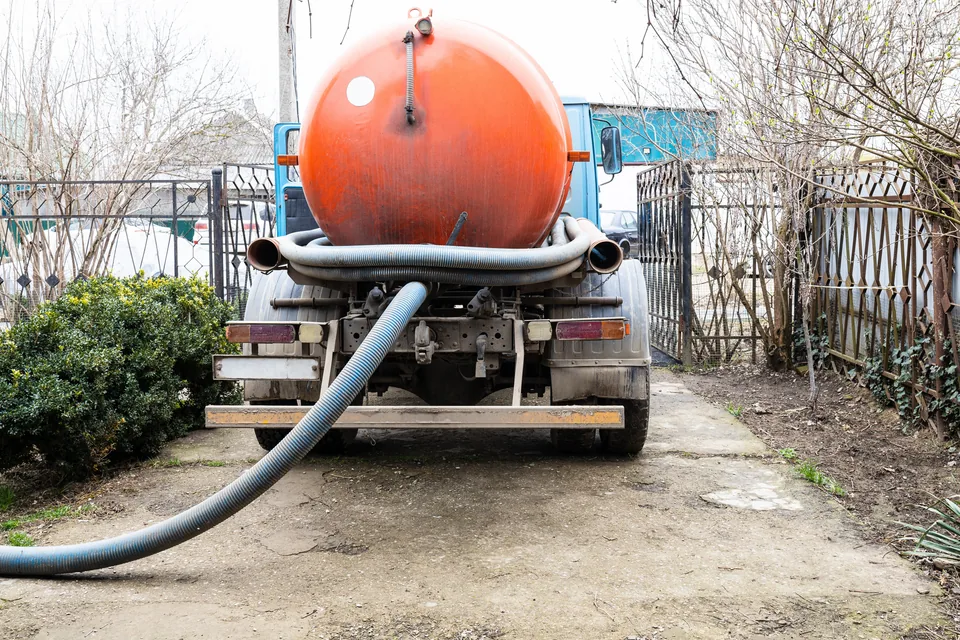
Pumping is its own approval, and so is the truck. WAC 246-272A-0310 opens “A person removing
septage from an OSS shall obtain approval from the local health officer before removal and:”,
with the definition at WAC 246-272A-0010(76) making a pumper one “approved by the local
health officer to remove and transport sewage or septage from an OSS.” The vehicle is a
separate instrument in the same section: WAC 246-272A-0310(1) requires the pumper to “Transport
septage or sewage only in vehicles clearly identified with the name of the business and
approved by the local health officer;”. The owner’s side of the duty closes the loop —
the rule puts a matching duty on whoever owns the system, at WAC 246-272A-0270(1)(f): “Employ
an approved pumper to remove the septage from the tank when the level of solids and scum
indicates that removal is necessary;”.
Two state regimes reach this operator less than it might expect. The transport-for-hire regime
does not reach it at all: RCW 81.77.010(9) defines the solid waste collection company that regime reaches as
one hauling “for compensation, except septic tank pumpers, over any public highway in this
state”, and that carve-out is the legislature’s own words. And the state environmental permit
is not automatic either. WAC 246-272A-0310(3) sends the pumper to the applicable law — “Dispose
of septage, or apply septage biosolids to land only in a manner consistent with applicable
laws.” — and that law, chapter 173-308 WAC, reaches the operator who applies septage to land or
treats it for that purpose, providing at WAC 173-308-310(1) that “All treatment works treating
domestic sewage are applicable facilities, and must apply for a permit for the final use or
disposal of biosolids or sewage sludge”. A pumper who hauls to a receiving facility and never
land-applies is not that person.
The inspection is mandated and the inspector is not licensed, and keeping those two apart is
the whole of this axis. WAC 246-272A-0270(1)(e) puts the duty on the system owner and the
qualification on the person doing the work: the owner must obtain an inspection “by a
maintenance service provider authorized by the local health officer of all OSS and property to
determine functionality, maintenance needs and compliance with this chapter and local rules,
and any permits”. That provider is defined at WAC 246-272A-0010(48) as “a management entity
certified by the local health officer and conducts a comprehensive analysis of an OSS.” —
quoted as published, ungrammatical as published. The cycle is set by system type rather than by
choice: “At least once every three years, unless more frequent inspections are specified by the
local health officer, for all OSS consisting solely of a sewage tank and gravity SSAS;” at
(e)(i), and “Annually for all other OSS unless more frequent inspections are specified by the
local health officer;” at (e)(ii). This axis is scoped too, and by a third thing the other axis
does not have: a local option that can move the qualification off the trade altogether.
WAC 246-272A-0340(3) provides that “The local health officer may establish a homeowner OSS
inspection certification process.”, so in a jurisdiction that establishes one a certified
homeowner is a lawful inspector of their own system — and RCW 70A.110.100 separately preserves
a county route, providing that nothing in that chapter “prohibits a county from relying on
self-inspection of on-site sewage systems”. Two state-issued credentials nearby are not routes a
septic contractor can take into this work. The state’s certificate of competency is issued to
government staff — RCW 18.210.190(1) reads “Employees of local health jurisdictions who review,
inspect, or approve the design and construction of on-site wastewater treatment systems shall
obtain a certificate of competency”, and the issuing board states its limit in its own words:
“If you have a certificate of competency, you may perform on-site design services for local
health jurisdictions, but may not practice as a licensed on-site designer.” The designer
license under chapter 18.210 RCW is a genuine state license for a different job, held by a
different person: RCW 18.210.005(2) provides that “It is unlawful for any individual to
practice or offer to practice the design of on-site wastewater treatment systems unless
licensed in accordance with this chapter”. One more duty is on the books and has not started.
WAC 246-272A-0270(1)(k)(ii) opens “Beginning February 1, 2027, obtain an inspection”, with the
qualification in the same subsection reading “by a third-party inspector authorized by the
local health officer”. That transfer inspection is written into the rule with its own start
date that has not yet arrived, so it is not a present duty, and it is a different job from the
recurring inspection rather than an alternative to it.
Almost none of that is an insurance requirement — the contractor registration’s insurance
minimums are the one place the two questions touch, and they are minimums for registration, not
adequate cover for this trade. Workers compensation is the exception that reshapes
everything else, because here it is not bought in the ordinary market: RCW 51.14.010 gives an
employer two options and no third, so unless a septic contractor is certified as a self-insurer,
its crew is covered through the state fund. The sections below set out each axis with the authority it rests on, so
you can check it rather than take our word for it.