Skip to content

Rhode Island

Septic Contractor Insurance in Rhode Island

Rhode Island licenses the installer of an onsite wastewater system as an individual rather than a business — and the one operator the licensing section leaves out is the owner of the home the system serves, on two written conditions.

Get a quote Call 317-942-0549

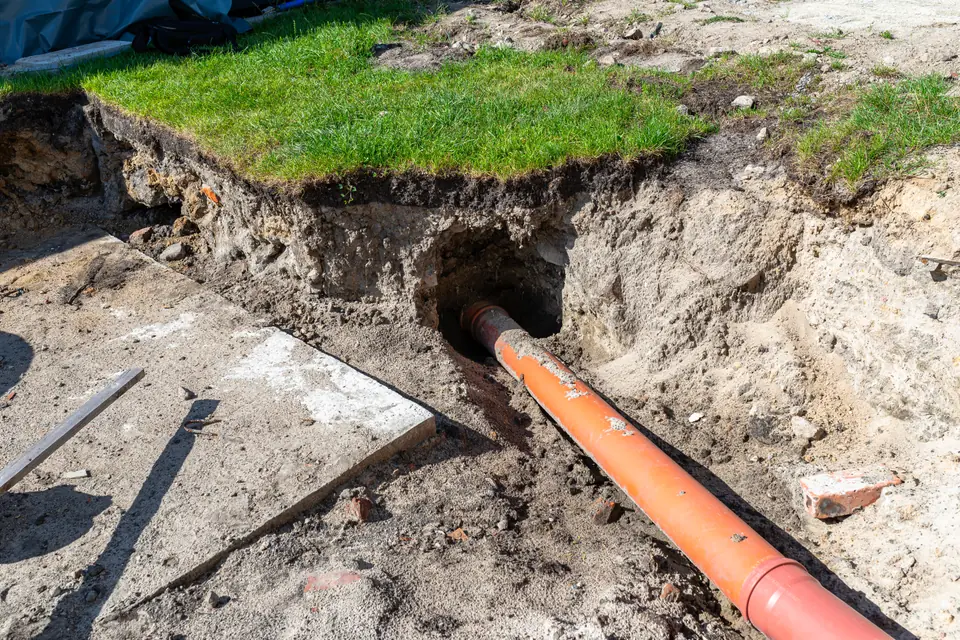
An orange sewer pipe laid in an open trench below a cut lawn edge — septic contractor insurance in Rhode Island

Rhode Island licenses the person who installs an onsite wastewater treatment system, and it is the person it licenses rather than the business. The prohibition is statutory at R.I. Gen. Laws § 5-56-1(a), and the department’s rule repeats that prohibition on the individual in its own words, quoted in full on this page. The counter is the state — the license is issued by the director of environmental management, under a chapter that makes the department itself the licensing authority — and there is no town office that issues it. It is examined rather than registered: § 5-56-2(c) requires a passing grade on a written examination intended to demonstrate the applicant’s understanding of the rules and the ability to read and interpret approved plans, and § 5-56-2(d) requires a demonstration of possession of and the ability to properly use a level or transit. It is personal: “The license shall be issued to natural persons only and is not transferable or assignable.” And it runs for a term rather than a season — § 5-56-6(a) provides that “Licenses shall be in effect for a period not to exceed three (3) years following the date of issuance.”

That duty does not reach every operator, and the licensing section writes its own exception into its second subsection. § 5-56-1(b): “This section does not apply to a property owner installing, constructing, altering, or repairing an individual sewage disposal system to serve a building he or she occupies or will occupy as his or her intended permanent domicile; provided, that he or she has obtained written permission for that work, and that he or she has obtained the necessary written approval of the director of the plans and specifications for that work prior to the start of any construction.” Read the proviso, because the exception is twice conditional and the proviso is the half that gets dropped: it takes written permission for the work AND the director’s prior written approval of the plans and specifications before any construction starts. An owner who begins without both is outside the exception, not inside it. And the exception belongs to the owner, not to a contractor — it reaches a property owner working on the building they occupy or will occupy as a permanent domicile, and nothing in it lets an unlicensed person install a system for somebody else. So the duty is scoped by one owner-occupier exception, conditioned on two prior approvals, and nothing wider.

Installing is one of several licensed judgments on the same job, and the state issues a separate license for each. Design is its own chapter: § 5-56.1-2 provides that “all plans, applications, evaluations, and certifications for the siting, location, design, installation, or repair of any individual sewage disposal system submitted to the department of environmental management shall be prepared by a person possessing an appropriate designer’s license issued by the director of the department of environmental management”. The rule then sets four classes. Class I authorizes the design of a repair and Class II adds alterations and smaller new construction, while “A Class III license authorizes the design of any OWTS provided for under these Rules.” Soil evaluation is its own class again — “A Class IV license authorizes the performance of soil evaluations described in § 6.16 of this Part.” — and it sits upstream of the installer, because a soil evaluation is a precondition of most applications. The two credentials touch at exactly one point: a licensed installer is the minimum qualification to sit the Class I examination. Beside all of them, and easy to mistake for them, is the per-lot approval the same rule requires before any work starts. That one is a different instrument written on a different subject — the licensing prohibitions are written on an “individual” and the approval prohibition on any “person”, which the rule defines to mean “any individual, group of individuals, firm, corporation, association, partnership or any Federal, State or municipal governmental entity.” The license sits on a human being; the approval reaches the business too.

Pumping and hauling is a different credential again, and it attaches the other way round. The statute is written on the business: § 23-19.4-1(a), set out in full in the pumper section of this page, opens on “No person, firm, corporation, partnership, or association” and requires a license for the business of pumping, cleaning and transporting septage. What the department issues is a septage transporter permit, and a decal is issued for each transportation unit that passes inspection rather than one for the fleet. The permit is administered inside the state’s hazardous waste rules, which is a filing location and not a classification — the same part keeps the two subjects apart, defining a transporter as “any person that transports hazardous waste other than on-site or that transports septage”, and nothing in it makes septage hazardous waste. The duties that follow the permit are operational and they are documentary at the same time: “Transporters hauling septage shall maintain records indicating the source and estimated volume of septage picked up, the date of shipment, and the receiving Publicly Owned Treatment Works (POTW).”, the transporter must report accidental discharges and spills immediately to the department, and it must collect what is accidentally discharged from the vehicle. The state also writes a liability figure into this permit: 250-RICR-140-10-1 § 1.8.3(C) provides that “transporters engaged exclusively in the transportation of septage need maintain liability insurance only sufficient to provide coverage of $300,000.00 (three hundred thousand dollars) per incident.”, against a higher figure, and a hazardous-materials rider, for a transporter that also moves hazardous waste or used oil. The word exclusively is the whole condition: a hauler that moves anything else the part reaches is outside the lower figure. That figure is a regulatory floor a permit is checked against — not an adequate limit and not a market norm.

Inspection is where the state writes a role and issues no inspector license itself. Rhode Island does not license septic inspectors, and that is a finding rather than a gap: the licensing sections of the same rule create four designer classes and an installer license and no inspector license, and the program that keeps the inspector registry states the negative itself. What the statute does create is a role. A system inspector “means a person who is registered as an inspector and capable of properly assessing the condition of an OWTS.”, and that role is compulsory in a narrow band rather than for inspections generally. At a property transfer where the manner of wastewater disposal is unknown, § 23-19.15-12(b) provides that “This inspection shall be done by a system inspector prior to the time of sale or transfer.” § 23-19.15-5(a) adds a standing duty in the coastal and drinking-water zones, where an owner “shall cause an inspection to be performed on said cesspool by a system inspector in accordance with a schedule established by the department”. Outside those two bands the state’s own instruments forbid nobody from looking at a system, and it is a town ordinance that supplies any further requirement. How a person qualifies is written only in the rule’s definition, and it is two routes rather than one: the definition describes a system inspector on a department-approved list “with the minimum qualifications of holding a Class I, II, or III Designers License or being a Registered System Inspector with the New England Onsite Wastewater Training Center.” The first route is a state license issued for another purpose; the second is registration with a training program at the state university, which the department neither issues nor examines but does adopt by reference and publish. Some towns then run their own approval of inspectors under their inspection ordinances, and that town approval is what decides who actually inspects where a program runs.

The credential and the insurance condition touch at the contractor registration, and this trade is exempt from all of it except the insurance section. A trade-blind contractor registration exists in this state, and this trade is exempt from it: § 5-65-2(a)(10) names the chapter that licenses septic installers among the state-licensed trades and provides that such a person or business entity “shall be exempt from all the provisions of this chapter except” the insurance section. So the registration does not reach a licensed installer working within the purview of the license — and the insurance condition does, because it is the one provision the exemption keeps. § 5-65-7(a) states the amount: “Throughout the period of registration, the contractor shall have in effect public liability and property damage insurance covering the work of that contractor that shall be subject to this chapter in not less than the following amount: five hundred thousand dollars ($500,000) combined single limit, bodily injury and property damage.” § 5-65-7(b) adds that “In addition, all contractors shall have in effect workers’ compensation insurance as required under chapter 29 of title 28.” And § 5-65-2(a)(10) makes the certificate the licensing agency’s business rather than a file in your office: “A valid certificate of insurance shall be required to be maintained by the licensing agency during the terms of the issuance date of the license as a condition for a valid license. Failure of the licensee to maintain this insurance shall result in loss of license pursuant to requirements of statutes governing the licensing authority.” No surety bond conditions any of this. The security this state asks of this trade is insurance, and a lapse is a license problem before it is ever a claims problem.

Workers compensation is a separate duty, it is compulsory, and it is bought in the open market. Rhode Island states no head count: § 28-29-6, whose words are set out in full in the workers compensation section of this page, turns on an employer who regularly employs people, and the operative words are regularly employs rather than a number — no section of the chapter converts them into one. § 28-36-1(a) then gives four lawful routes and no fifth, the first being insurance in the words quoted in that same section, with approved self-insurance on proof of financial ability, a combination of the two, and membership in an authorized group self-insurance fund as the others. There is no state fund among them; the chapter that once created one is published as repealed. Owners are treated apart from crews — a sole proprietor, a partner and a limited liability company member sit outside the definition of employee unless they have entered employment within the entity, and a corporate officer who was an employee first stays one until a waiver is filed — but none of those exceptions reaches a crew.

Two of the facts above are insurance requirements and the rest are not, which is why they are worth keeping apart. The local layer is a case in point: local ordinances can be stricter on standards and a municipal review step exists under § 6.18(C), but that is a different fact from who licenses: the state still issues both the installer and the designer credentials. The sections below set out each requirement with the authority it rests on, so you can check it rather than take our word for it.

What Rhode Island requires of a septic business

Installing

Rhode Island licenses the INDIVIDUAL who installs an onsite wastewater treatment system, the license is issued by the state environmental department’s director, and it is examined. A second, separate state license covers the person who DESIGNS the system, in four classes. The statutory prohibition is R.I. Gen. Laws § 5-56-1(a): "It is unlawful for any person to install, construct, alter, or repair, or cause to be installed, constructed, altered, or repaired, any individual sewage disposal system unless he or she has a valid annual license issued by the director of environmental management." The rule repeats it on the individual at 250-RICR-150-10-6 § 6.9(B): "No individual shall install, construct, alter, or repair an OWTS pursuant to these Rules unless such individual has a valid license in accordance with the provisions of these Rules to conduct such activity."

Authority R.I. Gen. Laws §§ 5-56-1(a) and (b), 5-56-2(b), (c) and (d), 5-56-4, 5-56-5, 5-56-6(a) and (b), 5-56-7, 5-56-8; §§ 5-56.1-1(b), 5-56.1-2, 5-56.1-3, 5-56.1-4(a)(2), (a)(3) and (b), 5-56.1-9; R.I. Gen. Laws §§ 5-65-2(a)(10) and 5-65-7(a), (b) and (c); 250-RICR-150-10-6 §§ 6.9(A), 6.9(B), 6.9(C), 6.10(A) to (E), 6.11(A), 6.11(B), 6.11(C), 6.12, 6.13, 6.14(A) to (D), 6.18(C), 6.47 — read the source

Pumping and hauling

Rhode Island licenses the septage BUSINESS, the credential is issued by the same state department that licenses the installer, and it is administered inside the hazardous waste rules rather than the onsite wastewater ones. The statute is R.I. Gen. Laws § 23-19.4-1(a): "No person, firm, corporation, partnership, or association shall engage in the business of pumping, cleaning, and/or transporting septage, industrial wastes, or oil waste unless a license is obtained from the department of environmental management." The instrument the department actually issues is named in 250-RICR-140-10-1 § 1.8.2(A): a Septage Transporter Permit, one per transportation unit.

Authority R.I. Gen. Laws §§ 23-19.4-1(a) and (b), 23-19.4-2, 23-19.4-3, 23-19.4-4; 250-RICR-140-10-1 §§ 1.1, 1.2(A), 1.5, 1.8.1(A), 1.8.2(A) to (E), 1.8.3(A) to (C), 1.8.4; 250-RICR-150-10-6 §§ 6.8, 6.9(J), 6.26, 6.29 — read the source

Inspecting and evaluating

Rhode Island writes a statutory role called the system inspector, requires that role for the inspection that decides whether a property has a cesspool at sale, and issues NO inspector license of its own. The program that maintains the inspector registry is a training program at the state university, and the department’s own licensing page links to it under the heading Septic System Inspectors. A number of towns then approve inspectors for their own ordinances. So the role is mandatory, the qualification is real, and the state is not the issuer of an inspector credential.

Rhode Island requires the role even though no inspector license exists: a system inspector must do the cesspool inspection before a property whose wastewater disposal is unknown is sold or transferred, and must also do the cesspool inspections the department schedules in the coastal and drinking-water zones. A system inspector must be on the department’s approved list and, at a minimum, hold certain classes of state designer license or appear on the inspector registry kept by the New England Onsite Wastewater Training Center, a program of the state university.

Authority R.I. Gen. Laws §§ 23-19.15-4(6), 23-19.15-5(a) and (b), 23-19.15-12(a), (b) and (c); 250-RICR-150-10-6 §§ 6.8, 6.40, 6.57(C)(1) to (3) — read the source

Workers compensation

Rhode Island’s workers' compensation duty attaches to an employer that regularly employs employees under a contract of hire, and it is discharged by insurance or by approved self-insurance rather than through any state fund. § 28-29-6 makes "Every person, firm, and private corporation, including any public service corporation, including the state, that regularly employs employees in the same business or in or about the same establishment under any contract of hire, express or implied" an employer subject to the act, and § 28-36-1(a) requires every such employer to "secure in one of the following ways the compensation for which the employer is or may become liable under those chapters", the first of which is "By insuring and keeping insured against liability to pay the compensation in any stock or mutual company, or association, authorized and qualified to do business in this state and to take those risks in this state".

Authority R.I. Gen. Laws §§ 28-29-2(2), 28-29-2(4)(iii), (iv) and (vi), 28-29-5, 28-29-6, 28-29-7, 28-29-8(a) and (b), 28-29-17, 28-29-19(b) and (c), 28-36-1(a), 28-36-15; title 27 chapter 7.2 [Repealed.] — read the source

What Rhode Island requires of a septic business — installing, hauling, inspecting and workers’ comp from private insurers — and what each requirement leaves to the insurance program.

A panel for Rhode Island in rows. Each row sets one thing the state requires beside the exposure that requirement leaves open and the coverage line that answers it. Installing: The state environmental department’s director licenses the installer after an examination. It leaves open a failed install or drainfield, damage to the customer’s property, which General Liability and Pollution Liability answer. Pumping and hauling: A septage hauling permit is required. It leaves open a spill or release in transit, the truck at fault, which Commercial Auto and Pollution Liability answer. Inspecting and evaluating: No statewide inspector or evaluator certification; it varies locally. It leaves open a missed defect in an inspection or design, which Professional Liability answers. Workers compensation: Compulsory for covered employers; private insurers write it. It leaves open an injured employee in the trench or on the truck, which Workers Compensation answers. Notes: A license, permit or bond is not a policy — a bond secures the public body that requires it, not the customer. The conclusion reads: The credential is not the coverage — the program is. No figures are shown.

Where we write in Rhode Island

Providence

Abandonment and tie-in work is excavation beside live utilities and confined below-grade structures, on lots with no room, and it is billed as a small job. The exposure is not the leachfield; it is the crush, the backfill and the neighbor’s driveway.

Warwick

Work scheduled by a closing date is work done under a deadline somebody else set, and a missed or defective abandonment lands in a real estate dispute rather than a service call.

Charlestown

A standing inspection program turns a one-off job into a recurring written opinion about somebody’s property, which is the professional exposure rather than the general liability one — and the person signing it is qualified through a registry rather than a state license.

Narragansett

A route business whose customers are on a municipal clock is a business whose paperwork is evidence. Two record sets — the town’s and the transporter’s — have to agree about the same truckload.

New Shoreham

When the tank is here and the treatment works is not, the load travels — and the exposure travels with it, as a full tanker in transit rather than as a job site.

Portsmouth

Unpermitted systems mean there is no record of what is in the ground, so the first hour of the job is discovery and the first risk is hitting something nobody documented.

Rhode Island questions we get asked

Does Rhode Island license septic installers?

Yes, and it licenses the person rather than the company. R.I. Gen. Laws § 5-56-1(a) makes unlicensed installation unlawful, and the department’s rule repeats the ban on the individual, in words quoted in full on this page. The license is issued by the state, by the director of environmental management, and it is examined — § 5-56-2(c) requires a passing grade on a written examination and § 5-56-2(d) requires the applicant to demonstrate possession of and the ability to properly use a level or transit. There is no town counter for it.

Can a property owner install a system without that license?

One operator is outside the licensing section, and the statute writes the exception itself. § 5-56-1(b): “This section does not apply to a property owner installing, constructing, altering, or repairing an individual sewage disposal system to serve a building he or she occupies or will occupy as his or her intended permanent domicile; provided, that he or she has obtained written permission for that work, and that he or she has obtained the necessary written approval of the director of the plans and specifications for that work prior to the start of any construction.” The proviso is the half that gets dropped: the exception is twice conditional, and an owner who starts digging without both the written permission and the director’s prior written approval of the plans and specifications is outside it. It is the owner’s exception and not a contractor’s — nothing in it lets an unlicensed person install a system for somebody else.

Does the license belong to my company or to me?

To you, and the rule says so in one sentence: “The license shall be issued to natural persons only and is not transferable or assignable.” § 5-56-4 adds that an installer’s license is not transferable and becomes invalid on a change of ownership. Pumping runs the other way. The septage credential at § 23-19.4-1(a) opens on “No person, firm, corporation, partnership, or association” and attaches to the business. So the company holds the license for pumping and not for installation, which stays with the natural person.

Do I need something separate to pump and haul septage?

Yes. It is a different chapter, a different rule part and a different subject, and holding the installer license does not confer it. § 23-19.4-1(a), quoted in full on this page, opens on “No person, firm, corporation, partnership, or association” and requires a license for that business. What the department actually hands over is a septage transporter permit, and a decal is issued for each transportation unit that passes inspection rather than one for the fleet. The statute fixes the anniversary: “All licenses shall expire on June 30 of each year unless sooner suspended or revoked”.

Does Rhode Island license septic inspectors?

No. It defines a system inspector in statute — the term “means a person who is registered as an inspector and capable of properly assessing the condition of an OWTS.” — and then requires that role in a narrow band rather than for inspections generally. At a property transfer where the manner of wastewater disposal is unknown, § 23-19.15-12(b) provides that “This inspection shall be done by a system inspector prior to the time of sale or transfer.”, and § 23-19.15-5(a) adds a standing duty in the coastal and drinking-water zones. Qualification is two routes, written in the rule’s definition: a Class I, II or III designer license, which the state does issue, or registration with the regional onsite wastewater training program at the state university, which it does not. Individual towns then approve inspectors for their own inspection ordinances.

Does the state tie my license to insurance, and do I need workers compensation?

It does tie the license to insurance, which is unusual, and it does it through the contractor registration this trade is otherwise exempt from. § 5-65-2(a)(10) exempts a person or business entity licensed under this trade’s own chapter from all of the registration chapter except its insurance section, and then provides that “A valid certificate of insurance shall be required to be maintained by the licensing agency during the terms of the issuance date of the license as a condition for a valid license. Failure of the licensee to maintain this insurance shall result in loss of license pursuant to requirements of statutes governing the licensing authority.” Workers compensation is separate and compulsory: § 5-65-7(b) states that “In addition, all contractors shall have in effect workers’ compensation insurance as required under chapter 29 of title 28.”, and the duty in that chapter reaches any employer who regularly employs people under a contract of hire, with no head count stated anywhere in it.

This page reports Rhode Island law as our own state research file records it. It is general information rather than legal advice, and it is not an opinion on what any policy covers — the wording you hold controls that, and carriers do not all write it the same way.

Talk it through with someone who reads the forms

Tell us what you install, what you pump and who is on the crew, and we will read the forms against the work.

Get a quote