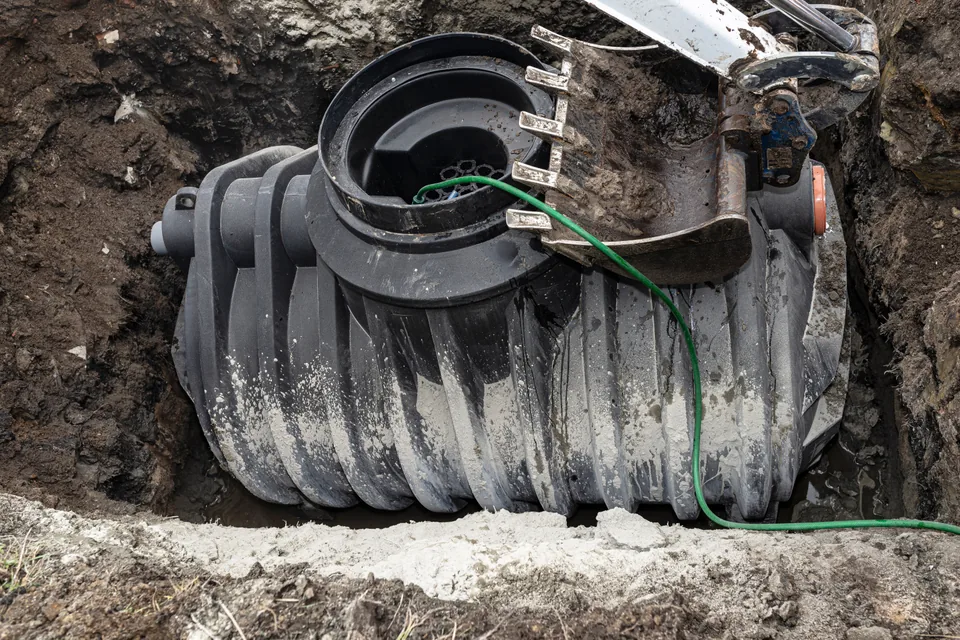
Massachusetts attaches a permit to the person who installs a septic system, and the rule that
creates it is a state rule. 310 CMR 15.019 opens: “No individual shall engage in the
construction, upgrade, modification, emergency repair, or expansion of any on-site system
without first obtaining a Disposal System Installer’s Permit from the Approving Authority.”
That regulation is the state environmental agency’s, promulgated under M.G.L. c. 21A, § 13, and
it applies of its own force everywhere in the Commonwealth. The body it names as the grantor is
a municipal one: 310 CMR 15.002 defines it as “Local Approving Authority - The board of health
or its authorized agent or an agent of a health district constituted pursuant to M.G.L. c. 111,
§ 27 acting on behalf of the applicable board of health.” Both of those have to survive into any
short answer about this state, and the two answers a contractor usually meets each drop one. The
answer that says no such credential exists here throws away a prohibition a state regulation
actually writes. The answer that treats it as a state license sends a reader to a counter that
does not exist. The shape is one rule and many counters, and the permit is issued by your local
board of health against a standard the Commonwealth wrote.
The section that creates that duty writes no way out of it. It runs on to the permit’s term, to
the competence standard and to suspension and revocation by order, and on its face it sets no
proviso, no dollar band, no owner-doing-their-own-work limb and no class of operator outside it
— a reading taken against the whole of Title 5 as the agency publishes it rather than against
the one section. Two things in the rule look like exceptions and are not. For state and federal
systems, for facilities at or above a stated design flow, for variances and for alternative
systems, 310 CMR 15.003(2) makes the state environmental agency itself the Approving Authority:
that moves the counter and leaves the duty exactly where it was. And Title 5’s own applicability rule governs which systems may be
approved, not who has to hold a permit before touching one. Neither is an exemption from the
permit: the counter moves and the duty does not, so the person-attaching permit stays
unqualified on the face of the state rule.
Two Massachusetts permits have almost the same name, and they are two different documents doing
two different jobs. The one above attaches to a person. The other attaches to a job:
310 CMR 15.020(1) provides that “No person shall construct, upgrade, modify or expand a system
without a Disposal System Construction Permit which has been issued by the Approving Authority
after the site evaluation set forth in 310 CMR 15.100 through 15.107 has been completed.” One
system, one lot, its own expiry. A contractor needs both, and a page that
carries only the per-job construction permit is describing the wrong credential. A construction permit ends with
the job, while the personal permit runs for a capped term, is revocable by order, and follows the
holder from one job to the next. The test behind the personal one is written by the
state and not left to a town’s discretion — “The Local Approving Authority shall issue Disposal
System Installer Permits only to those individuals who have demonstrated knowledge of and
experience with the proper construction and installation of systems in accordance with
310 CMR 15.000.” Demonstrated knowledge and experience is a competence test, which is what makes
this a trade credential rather than a business registration.
Which board of health is the one that matters has a specific answer: the board for the city or
town where the work is performed, not the one where the business keeps its yard, and not any
county office. The permit does not travel. It is granted by the local approving authority for
the place where the work is done, so a contractor working across a group of towns holds a
separate installer permit from each town’s board of health, each on its own term. The floor under all of them is the state’s, and a board may sit above it but not
below it: 310 CMR 15.003(3) allows that “Local approving authorities may enact more stringent
regulations to protect public health, safety, welfare and the environment only in accordance with
M.G.L. c. 111, § 31”. These boards are municipal bodies rather than state offices wearing a local
name, and three sections say so. M.G.L. c. 111, § 26 has city boards appointed by the mayor,
subject to local confirmation, and provides that “Boards of health in towns shall be chosen as
provided in chapter forty-one.” Section 27 lets each board organize itself, choose its own clerk
and “employ the necessary officers, agents and assistants to execute the health laws and its
regulations”. Section 31 gives it its own regulation-making power. The public-health chapter
names this trade exactly once, and not to license anybody: a local-acceptance section deals with
the conflict of interest that arises when a septic system installer sits on the board of health
that permits installers, and bars that member and that board from inspecting the member’s own
work. It creates no credential at all. What it presupposes is the useful part: the legislature
wrote a conflict rule for an installer sitting on the board that permits him, which confirms
that the permitting counter is a municipal one.
One local variable is worth settling before anyone issues a certificate of insurance. The state
rule binds an individual. A town’s own code can reach further, and at least one does: the Town
of Chatham Board of Health publishes a subsurface disposal code providing
that “DISPOSAL SYSTEM INSTALLER’S PERMIT - No person or firm shall engage in the construction,
expansion or upgrade of an on-site subsurface sewage disposal system without first obtaining a
Disposal System Installers Permit from the Board of Health or its Agent.” That is one town’s
rule and not the Commonwealth’s, and this page makes no claim about how Massachusetts towns
vary generally. What it does show is that whether the permit sits on the owner personally or on
the company can have a different answer from one counter to the next — and a certificate issued to
the entity is silent on which of the two holds it. That question decides who is suspended when a job
goes wrong.
The permit reaches the person who builds the system and stops there, and the rest of the lot is
credentialed elsewhere. Design is reserved to two state registrations: “Every system shall be
designed by a Massachusetts Registered Professional Engineer or a Massachusetts Registered
Sanitarian”, with a design-flow ceiling on the sanitarian, under 310 CMR 15.220(1). Reading the
soil is a state approval of its own — a Soil Evaluator is defined as “A person approved by the
Department pursuant to 310 CMR 15.017 as capable of evaluating the suitability of a specific
site for the use of an on-site subsurface sewage disposal system in compliance with
310 CMR 15.000.” So an ordinary residential lot here is worked across three separate counters:
a state approval for the person who reads the ground, a state registration behind the stamped
plan, and a town permit for the person who digs. A septic firm that employs its own soil evaluator
has taken on a certification liability the digging does not carry.
That is the kind of exposure a general liability policy was not bought to answer.
On inspection the state reverses its own pattern, and it is easy to write backwards. The
installer and the hauler hold town permits; the inspector holds an approval from the
Commonwealth. Under 310 CMR 15.340 a System Inspector is someone the state environmental agency
has approved, drawn from a closed list of qualifying backgrounds once its training and
examination are passed, and 310 CMR 15.340(3) states the effect flatly: “No persons other than those listed at
310 CMR 15.340(1) may perform inspections required by 15.301.” The trigger has to travel with
every sentence about that inspection, because without it the rule reads as something
Massachusetts does not impose. 310 CMR 15.301(1) provides that “Except as provided in
310 CMR 15.301(2), 15.301(3), and 15.301(4), a system shall be inspected at or within two years
prior to the time of transfer of title to the facility served by the system.” That is a
transfer-of-title rule and not a standing duty on every owner: 310 CMR 15.301(2) lists
transactions that are not transfers for this purpose — among them taking a security interest,
refinancing, a change in the form of ownership among the same owners, adding or deleting a
spouse, and a change of guardian, conservator or trustee — and 310 CMR 15.301(4) lists further
exclusions. Condominium and cooperative facilities run on their own recurring schedule instead.
The closed list has the installer on it, and that produces a role collision worth pricing. The
same person can hold a town’s installer permit and the state’s inspector approval, and
310 CMR 15.340(11) lets an approved inspector act either as the approving authority’s agent or
as the owner’s independent agent. An inspector’s opinion decides whether a sale closes, and
conducting an inspection that incorrectly passes or fails a system is itself a ground for the
state to revoke the approval — so the exposure runs in both directions, toward the buyer who
inherits a failed system and toward the seller whose sale collapsed on a wrong fail. That
installer is wearing two hats with two different liability shapes on the same street, and a
policy written for excavation does not see the professional liability of the second hat the
same way.
Pumping is permitted at the same municipal counter as digging, so both halves of the trade
answer to one board rather than two. 310 CMR 15.502(1) provides that “No person shall remove
and/or transport septage through the streets of any city or town or via any state or federal
highway located within any city or town in which the septage was first collected without first
obtaining a permit from the board of health of such city or town in accordance with
310 CMR 15.000 and M.G.L. c. 111, § 31A.” Read the geography in that sentence, because it sets
the paperwork: the permit is needed from every city or town where septage is collected, each one
expiring at the end of the calendar year under 310 CMR 15.502(2) and none transferable without
that board’s written approval. A town merely driven through is a different instrument —
“A duly registered septage hauler may transport septage through the streets of a city or town in
which said substances were not collected provided the hauler registers with the board of health
of such city or town”, on the reasonable rules that board sets. A route that crosses several
towns therefore carries several pieces of paper of two different kinds, all expiring together at
the year’s end. The equipment is permitted as well, which is unusual and is an underwriting fact
rather than a filing detail: “No person shall use equipment to remove or transport the contents
of privies, cesspools, septic tanks or tight tanks unless such equipment has first been inspected
and approved by the Approving Authority.” A replacement truck put into service mid-season is a
truck the board has not yet approved. The single exemption in that subpart is for public vehicles
— “Motor vehicles owned by the Commonwealth or any of its political subdivisions and motor
vehicles engaged under contract with the Commonwealth in the transportation of septage” — and a
private contractor hauling for private customers sits outside it.
Workers compensation is asked of every employer here and no floor is set under it.
M.G.L. c. 152, § 25A opens: “In order to promote the health, safety and welfare of employees,
every employer shall provide for the payment to his employees of the compensation provided for
by this chapter”. The Department of Industrial Accidents publishes the same rule in plainer
words — “All employers operating in Massachusetts are required to carry workers’ compensation
insurance for their employees and themselves if they are an employee of their company.” and
“The requirement applies no matter the number of hours worked or the number of employees.” A
septic outfit with one helper is inside it on the first day. There is no state fund to fall back
on: § 25A offers insurance with an insurer, membership in a workers compensation self-insurance
group, or an annual self-insurer license granted on a deposit or a surety bond with reinsurance,
and nothing else. Sole proprietors and partners sit outside the definition by default and elect
in by buying the cover. A qualifying officer or director may elect out, but only on a filing —
“Notwithstanding section 46, these provisions shall apply only if the corporate officer provides
the commissioner of industrial accidents with a written waiver of his rights under this chapter.”
That election is not self-executing, and an officer who assumes it without filing is simply
uninsured. On members of a limited liability company the statute says nothing and the
administering department does: it publishes that “Members of a limited liability company (LLC),
partners of a limited liability partnership (LLP), or sole proprietors of an unincorporated
business aren’t required to carry workers’ compensation insurance for themselves”, and that the
exemption does not reach employees who are not members. That is the department’s position,
attributed to the department and not to the statute, which is silent on members of a limited
liability company.
The homeowner carve-out in the definition of employer, at § 1(5), is the sentence most often read
backwards on this trade.
Section 1(5) provides that “the owner of a dwelling house having not more than three apartments
and who resides therein, or the occupant of a dwelling house of another who employs persons to do
maintenance, construction or repair work on such dwelling house or on the grounds or buildings
appurtenant thereto shall not because of such employment be deemed to be an employer.” That
excuses the homeowner who hires the work, on the dwelling and the ground around it — which is
exactly where a septic system sits. It excuses nobody who performs the work. The other exclusions
in the chapter reach seamen, certain athletes, commission-only real estate salespeople, some
direct sellers, leased taxicab operators and people covered by federal law. None of them reaches
a septic crew, and there is no small-employer exemption of any kind.
And in Massachusetts the coverage question and the credential question are one conversation
rather than two. M.G.L. c. 152, § 25C(6): “Every state or local licensing agency
shall withhold the issuance or renewal of a license or permit to operate a business or to
construct buildings in the commonwealth for any applicant who has not produced acceptable
evidence of compliance with the insurance coverage required by this chapter.” The board of health
granting a Disposal System Installer’s Permit is a local licensing agency. So a lapse does not
merely expose an employer to a claim — it reaches the renewal of the permit the crew works under,
and § 25C(7) bars the Commonwealth and its subdivisions from contracting for public work without
the same evidence. The enforcement limb shuts the site rather than the office: on a determination
of non-compliance “a stop work order shall be served on said employer, requiring the cessation of
all business operations at the place of employment or job site”, effective immediately on
service, with a civil penalty running by the day from the date it is served until coverage is
shown and the penalty paid, and the statute raises that daily figure against an employer who
appeals and loses.
Almost none of the rest is an insurance requirement. The residential contracting registration
carries no insurance condition and no bond, and the guaranty fund its registrants pay into is
neither a surety bond nor liability insurance — a page that calls it one is wrong about both.
What the Commonwealth does instead is make workers compensation coverage a precondition of
holding the credential the trade runs on.
The rest is left to the contract you sign and the board you answer to. The sections below set out each credential with the authority
it rests on, so you can check it rather than take our word for it.