Skip to content

New Mexico

Septic Contractor Insurance in New Mexico

New Mexico forbids the work without a state contractor’s license, in a classification written for this trade — and the exception written into that same sentence releases one defined person, not a class of jobs.

Get a quote Call 317-942-0549

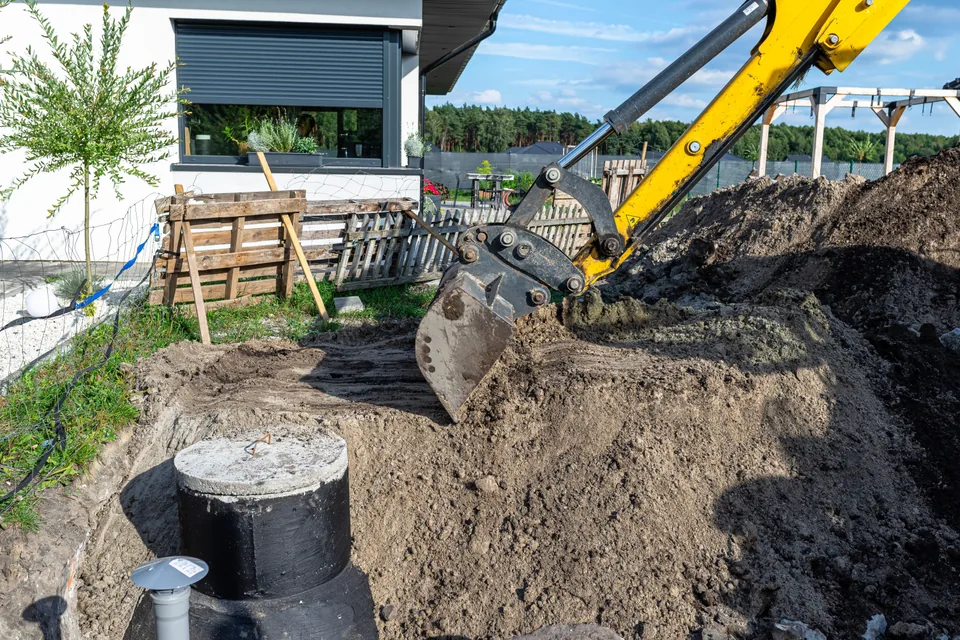
A backhoe arm backfilling soil around a buried septic tank riser near a house — septic contractor insurance in New Mexico

New Mexico forbids anyone to construct, install or modify an on-site liquid waste system without a contractor’s license in an appropriate classification, issued by the state. The prohibition lives in the Environmental Improvement Board’s liquid waste rule rather than in the licensing act — it opens “No person shall construct, install or modify an on-site liquid waste system” — while the license it demands is issued by the construction industries division of the state’s regulation and licensing department. The classification written for this trade is a mechanical specialty for septic tanks and sewer; the plumbing classification and the combined mechanical classification reach the same work. A contractor who reads only the licensing rules, or only the environmental ones, comes away with half of that.

That duty does not reach every person who puts a system in the ground, and the rule says precisely whom it releases, in a clause of the same sentence: “except that a qualified homeowner may install or modify permitted septic tanks and conventional trench or bed disposal fields.” A qualified homeowner is a defined and examined person — the rule “means a person who is the owner residing at the property who has been provided homeowner installation training materials and who has passed an exam administered by the department” — and the release is bounded four more times after that. It runs to that person’s own personal residence; a qualified homeowner “shall not install or modify an on-site liquid waste system serving a rental unit”; the qualification is valid for a year unless the department extends it for good cause; and “A qualified homeowner may install no more than one liquid waste system during a twelve month period.” So it is not a general homeowner exemption, and it is not a way round the license for anyone working for hire: a qualified homeowner who self-installs “shall not compensate any person to perform any phase of the system construction” unless that person holds the license.

The credential is two documents, which a sole operator should read twice. The license is issued to the business entity, and that entity has to employ or be owned by a natural person the division has certified as its qualifying party for the classification; the license grants “only the authority to engage in contracting in the classification specified on the license issued to the entity, and on the certificate issued to its qualifying party”. One person trading alone holds both, and an entity that ceases to be qualified by a certified qualifying party loses the license. Initial licensure and every renewal also turn on a bond “underwritten by a corporate surety authorized to transact business in New Mexico”, and “Maintaining the bond for the entire period of licensure is a condition of licensure.” Read that bond for what it is. It is not liability insurance and it does not answer to an injured third party: payment from it “shall be used to cure division certified code violations caused and not corrected by the licensee”.

The license and the per-system permit are separate instruments. A system is permitted job by job, on an application that goes “to the field office of the department having jurisdiction for the area where the system is to be installed or modified”, so a business working both ends of the state files with more than one office under one statewide rule. Nobody may operate or use the system before the department grants final approval, which makes a misfiled permit a work stoppage rather than paperwork. A voluntary certification changes how the inspection step runs: the state environment department certifies installer specialists, and where a specialist has given the required notice and the department’s inspector has not arrived within an hour of the notified time, the specialist photographs the components, completes a departmental inspection form and may complete the installation. One county — Bernalillo — runs its own onsite wastewater ordinance, on the department’s own statement, and it runs only in the unincorporated part of that county; the incorporated municipalities inside it are regulated by the department. Even there the installer’s own credential does not change, because no county issues it.

A property transfer brings a compulsory evaluation, and New Mexico issues no license for the evaluator. The duty attaches to the transaction rather than to the system: before a property with an established on-site liquid waste system is transferred, “the transferor of the property shall have the system evaluated”, by an evaluator qualified under the rule. Six routes lead to that qualification, and the rule names each one. One is “a valid and appropriate classification of licensure by the construction industries division of the regulation and licensing department”. Another is “licensure as a professional engineer”. A third is “accreditation in on-site wastewater inspection by the national sanitation foundation (NSF)”. A fourth is “certification by the national environmental health association (NEHA) as an installer of on-site wastewater treatment systems”. A fifth is “certification as a registered environmental health specialist (REHS) or a registered sanitarian (RS)”. The last is “demonstration of a similar accreditation or certification or a combination of training and experience as approved by the department”. Three of those are private accreditations the rule adopts by reference, and none of them is a New Mexico body. So the role is compulsory while the state licenses no inspector, and the license that is required to install is merely one of six ways to qualify to evaluate. Advanced treatment systems are carved out of all six and left to maintenance service providers.

What attaches to the evaluation report is a filing duty and a fifteen-day clock. Every evaluation goes to the department within fifteen days, and the rule is emphatic that an abandoned or unwelcome one goes as well: “Once an evaluation is requested, all results, whether complete or not, shall be submitted to the department.” Where the evaluation identifies a deficiency, a permit or variance application follows within fifteen days from whoever owns the property on the fifteenth day — so an evaluator’s report is a document with a deadline attached to it.

One more New Mexico rule closes a loop most states leave open. The compensation Act reaches employers by a worker count in general, and then applies to every employer whose activities the Construction Industries Licensing Act requires to be licensed, in words set out in full below — “regardless of the number of employees”. A septic contractor here is exactly that employer, because the environmental rule forbids the work without the license, so the duty starts at the first worker rather than at a headcount. Failing to comply with compensation law is also among the events that can make the license itself invalid, which means the cover and the right to work are not two separate compliance items. The sections below set out each finding beside the authority it rests on, so none of it has to be taken on our word.

What New Mexico requires of a septic business

Installing

New Mexico attaches a credential to the PERSON AND BUSINESS who installs a liquid waste system, and it is a state contractor’s license in a classification named for this trade. The Environmental Improvement Board’s liquid waste rule forbids the work outright without it, and the rule’s own definition of the installer IS the holder of that license. A separate, voluntary state certification — installer specialist — sits on top of it and confers real authority.

Authority 20.7.3.401(C) NMAC; 20.7.3.401(A) NMAC; 20.7.3.7 NMAC (definitions, “installer”); 20.7.3.401(Q) and (R) NMAC; 20.7.3.401(E) NMAC; 14.6.6.11(C)(1) NMAC; 14.6.6.11(B)(1) and (B)(5) NMAC; 14.6.3.8(A)(1) NMAC; 14.6.3.8(C)(1) NMAC; 14.6.3.8(K)(1)(b) and (K)(1)(c) NMAC; 20.7.3.904(A)(7) NMAC; 20.7.3.904(E) NMAC; 20.7.3.203(B)(4) NMAC — read the source

Pumping and hauling

New Mexico’s septage instrument is OPERATOR-LEVEL and nothing else: a septage pumper qualification issued by the environment department under the liquid waste rule, with mandatory competence, equipment, contingency-planning and notification duties attached. There is NO vehicle-level instrument — no septage vehicle permit, registration, decal or marking requirement — and the state’s solid waste hauler registration does not reach septage.

Authority 20.7.3.904(D) NMAC; 20.7.3.904(F) NMAC; 20.7.3.306 NMAC; 20.7.3.2(B) NMAC; 20.7.3.808(L) NMAC; 20.7.3.401(J)(1) NMAC; 20.9.2.7 NMAC (definitions); 20.9.3.31(A) NMAC — read the source

Inspecting and evaluating

New Mexico mandates the ROLE and issues no license for it. A property-transfer evaluation is compulsory before transfer, it may be done only by an evaluator qualified under the rule, and the rule then opens SIX alternative routes to that qualification — two of them state licenses held for other purposes, three of them non-state accreditations the rule adopts by reference, and one a discretionary departmental approval. There is no New Mexico septic inspector license: the state mandates the role and issues no credential of its own for it.

read the source

Workers compensation

New Mexico applies its Workers' Compensation Act to employers of three or more workers, but removes the employee count entirely for construction: the Act "shall apply to all employers engaged in activities required to be licensed under the provisions of the Construction Industries Licensing Act" — and a New Mexico septic contractor is exactly such an employer, because 20.7.3.401(C) NMAC forbids the work without that license — so coverage is compulsory for this operator from the first worker, placed with an authorized insurer or, on proof of financial solvency to the director, self-insured.

Authority 52-1-2 NMSA 1978; 52-1-4(A), (C) and (D) NMSA 1978; 52-1-6(A) and (B) NMSA 1978; 52-1-7(A) to (F) NMSA 1978; 14.6.3.8(K)(1)(c) NMAC — read the source

What New Mexico requires of a septic business — installing, hauling, inspecting and workers’ comp from private insurers — and what each requirement leaves to the insurance program.

A panel for New Mexico in rows. Each row sets one thing the state requires beside the exposure that requirement leaves open and the coverage line that answers it. Installing: A state contractor’s license in a classification named for this trade. It leaves open a failed install or drainfield, damage to the customer’s property, which General Liability and Pollution Liability answer. Pumping and hauling: Septage hauling carries permit duties, with sanctions. It leaves open a spill or release in transit, the truck at fault, which Commercial Auto and Pollution Liability answer. Inspecting and evaluating: A state inspector or evaluator certification is required, and local rules vary too. It leaves open a missed defect in an inspection or design, which Professional Liability answers. Workers compensation: Compulsory for covered employers; private insurers write it. It leaves open an injured employee in the trench or on the truck, which Workers Compensation answers. Notes: A license, permit or bond is not a policy — a bond secures the public body that requires it, not the customer. The conclusion reads: The credential is not the coverage — the program is. No figures are shown.

Where we write in New Mexico

Albuquerque · Bernalillo County

Two permit regimes inside one service radius means two sets of paperwork conditions inside one policy year, and a mis-filed permit is a work-stoppage exposure rather than a paperwork one, because 20.7.3.401(N) forbids anyone to operate or use the system until the department has granted final approval.

Rio Rancho · Sandoval County

Work driven by new construction rather than by failure means the septic contractor is one trade inside a general contractor’s sequence, which is where additional-insured and contractual-liability questions arrive on a septic account.

Las Cruces · Doña Ana County

A crew whose jobs sit under several field offices carries more scheduling risk on inspections than one working a single office’s territory, and 20.7.3.203(B)(1) puts the consequence of a missed inspection window on the installer’s own photographic record.

Santa Fe · Santa Fe County

An advanced system commits the owner to a continuing maintenance contract, and 20.7.3.903 puts sampling, reporting and a 48-hour emergency response duty on whoever holds it. A contractor who signs those contracts has taken on a recurring service obligation with a response clock, not a one-off installation.

Farmington · San Juan County

An operator working across a state line is carrying credentials under two regimes, and the compensation duty in this state is keyed to this state’s licensing act and does not follow the truck.

Roswell · Chaves County

A holding tank ties the contractor’s completed work to a pumping schedule someone else keeps — 20.7.3.808(L) puts the pumping duty and a seven-year manifest-retention duty on the OWNER — so a failure argument can turn on whose neglect the overflow was, which is the classic completed-operations dispute on this trade.

Los Lunas · Valencia County

A transfer evaluation that reports a deficiency starts a fifteen-day clock under 20.7.3.902(H) for a permit or variance application by whoever owns the property on the fifteenth day, which turns an evaluator’s report into a document with a deadline attached and is the sharpest professional-liability surface on the inspection axis.

Gallup · McKinley County

Long-radius work concentrates equipment on the road rather than on the site, which moves exposure from the excavation onto the haul, and a canceled permit turns an open excavation into an owner’s duty to eliminate public safety hazards under 20.7.3.401(Q).

New Mexico questions we get asked

Does New Mexico require a license to install a septic system?

Yes, and the rule forbids the work rather than merely conditioning it. Nobody may construct, install or modify an on-site liquid waste system without a contractor’s license in an appropriate classification, issued by the state — and the classification that names this trade is a mechanical specialty for septic tanks and sewer, with two broader mechanical classifications reaching the same work. The prohibition sits in the environmental rule; the license comes from the construction industries division.

Does the homeowner exception let an unlicensed person take the work?

No. The exception is written into the prohibition’s own sentence and releases one defined person: a qualified homeowner, meaning an owner residing at the property who has been given the department’s training materials and passed its exam. It runs to conventional tanks and trench or bed fields on that person’s own residence, not a rental, one system in a twelve month period, on a qualification that lasts a year. And a qualified homeowner who self-installs may not pay anyone unlicensed for any phase of the construction.

Does my company hold the license, or do I?

Both. The license is issued to the business entity, and that entity has to employ or be owned by a natural person the division has certified as its qualifying party for the classification. The license grants authority only in the classification named on it and on that person’s certificate, and an entity that ceases to be qualified by a qualifying party loses the license.

Is the license the same thing as the permit for the job?

No: the license and the per-system permit are separate instruments. The license is statewide and travels with the business. The system is permitted job by job, on an application to the field office of the department having jurisdiction where the system is to be installed, and nobody may operate or use it until the department has granted final approval. One county runs its own onsite wastewater ordinance in its unincorporated portions; even there, the installer’s credential is still the state license.

Does New Mexico license septic inspectors?

No. The role is mandatory, but the state issues no inspector license for it. Before a property with an established system is transferred, the transferor has to have the system evaluated, and only an evaluator qualified under the rule may do it — by any one of six routes, three of which are private accreditations the rule adopts by reference. The license that is required to install is one of those six ways to qualify to evaluate, which is not the same thing at all. Advanced treatment systems are carved out and left to maintenance service providers.

Do I need workers compensation for a small crew in New Mexico?

From the first worker, yes. New Mexico’s compensation Act reaches employers by a worker count in general, and then applies to every employer whose work the state’s construction licensing act requires to be licensed, regardless of the number of employees. A septic contractor is exactly that employer, because the environmental rule forbids the work without the license. Failing to comply with compensation law is also an event that can make the license invalid.

This page reports New Mexico law as our own state research file records it. It is general information rather than legal advice, and it is not an opinion on what any policy covers — the wording you hold controls that, and carriers do not all write it the same way.

Talk it through with someone who reads the forms

Tell us what you install, what you pump and who is on the crew, and we will read the forms against the work.

Get a quote