West Virginia requires a state certificate to install an on-site sewage system, issued by the
state in a class that matches the system. The certifying body is the health agency’s
sanitation division, and its own one-line statement of that duty is set out below the body. The
rule’s own scope line names the certification of installers too, and it is quoted in full there
rather than twice. The second sentence a West Virginia reader is owed is that the SYSTEM needs a
permit of its own before the work starts, and the certificate does not stand in for it:
W. Va. Code §16-1-9 provides that “No person, firm, company, corporation, institution or
association, whether public or private, county or municipal, may install or establish any system
or method of drainage, water supply, or sewage or excreta disposal without first obtaining a
written permit”. A certified person, and a permitted lot. They are two instruments and they fail
separately.
There is a limit on this page, and it is better stated than written around. West Virginia’s
sewage rule is published by the Secretary of State in two forms and neither is machine-readable:
a scan with no text layer, and a binary word-processor file. That is a publisher limit and never
a doubt about the text, but a span nobody downstream can re-fetch cannot be checked, so the rule
is described on this page rather than quoted. That has one consequence, and it is a consequence
about reach rather than about the duty. The rule’s mandate provides for routes around the
certificate, which the record carries only as mentions because the publisher serves no
machine-readable copy of that part of the rule, so this page does not print their terms. So the
certificate requirement is stated above only as far as the evidence carries it: this page does
not say that all installers must be certified, and it does not say that any particular installer
need not be.
That is a question about the work you are actually taking on, and it is one to put to the
sanitation division, or to us, before you price it. What the rule does do plainly is enforce
itself — a violation of any of its provisions routes to W. Va. Code §16-1-18, which sets “a fine
of not less than $50 nor more than $500” and makes each day’s failure a separate offense.
The class is the part a working contractor will check this page against, and it decides which
jobs are open. The lower class reaches standard soil absorption systems, soil absorption beds,
holding tanks and effluent lift stations. The higher class reaches all of those plus the
alternative and other on-site systems the design-standards rule sets out — the systems that
difficult ground forces on a job. The rule requires a written examination for each
classification, so each class is a certificate in its own right and not something the other one
carries. The underwriting note below takes up what the wrong class means on an alternative-system
job. The term is stated by the agency itself — “On-Site Sewage System Installer
certifications are valid for five years from date of issuance.” — and renewal runs through a
recommendation from the local health department in counties knowledgeable of the individual’s
work, which is a local input to a state grant and never a county credential of its own. A policy
year can comfortably outlive a certificate term.
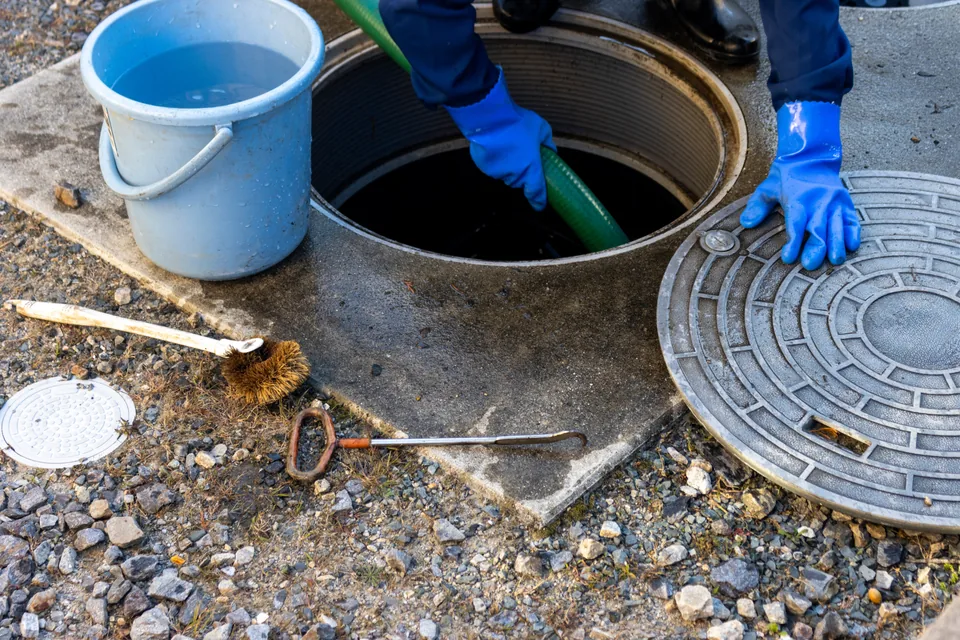
Pumping is a different instrument, and a page that tells an operator who both installs and pumps
that they need a license has told them nothing usable. The tank cleaner holds a
BUSINESS permit from the same agency
under the same rule: the application goes in where the business sits, the permit is the state
director’s and works state-wide, and the agency will not grant it until it has inspected the
equipment and has proof of somewhere lawful to empty the truck. “A person engaging in the
business of sewage tank cleaning shall receive a permit only after application has been made on
a form prescribed by the director”, and “The application shall include documentation that a
disposal site approved by the department of environmental protection will be used for disposal
of the sewage.” That outlet is the part an insurance reader should sit up for, because it is a
permit condition rather than a business preference. Written permission is required from the
plant — “If permission is granted to the septage hauler for disposal of septage, the owner and
operator of the public sewage treatment plant shall grant permission in writing.” — and the set
of plants that may take it is short: “The disposal of septage shall not be in a public sewage
treatment plant treating less than 100,000 gallons per day, unless providing pre-treatment.” at
64 CSR 47 §8.1.b. Lose the outlet and you have not lost a customer, you have lost the permit.
The permit rides on the truck, too, in the rule’s own words: “The health department permit number
for the sewage tank cleaner shall be prominently displayed on the carrier tank.”
The certificate is not all a septic business needs, and the second credential is the one that
carries the money. West Virginia’s contractor license is TRADE-BLIND — it names no septic class
at all, and the board’s own examination classifications run from excavation and general
engineering through piping and plumbing without one — but it reaches this operator anyway.
W. Va. Code §30-42-6(a): “No person may engage in this state in any activity as a contractor or
submit a bid to perform work as a contractor, as defined in this article, unless that person
holds a license issued under the provisions of this article.” The size test lives in the
definition rather than in the prohibition, at §30-42-3(d), which reaches work “where the cost of
the undertaking is $5,000 or more for residential work or $25,000 or more for commercial work”.
Then come the conditions, and they are insurance conditions: before the license issues,
§30-42-5(e) has the applicant certify by affidavit that the applicant “Has registered, and is in
compliance, with the workers’ compensation fund and the employment security fund” and “Is in
compliance with the applicable wage bond requirements of §21-5-14 of this code”. A workers
compensation condition and a wage bond — not a general liability limit, which nothing read for
this page asks of either credential. Note too that the license comes
from the Contractor Licensing Board, whatever an older document may say about where to apply,
and neither credential is the gate to the other: the agency’s own certification material states
that “A Sewer System Installer Certification can be obtained prior to getting a contractor’s
license”.
Workers compensation is where West Virginia is most often described from memory, and the memory
is a generation out of date. The state ran a monopolistic fund and stopped: W. Va. Code
§23-2C-1(c) records that “The state opened to a private, competitive market for workers’
compensation insurance on July 1, 2008.”, and §23-1-1(c) records that “the Workers’ Compensation
Commission was terminated on December 31, 2005” with ratemaking and the adjudication of claims
moved to the Insurance Commissioner. Coverage is compulsory, and the duty is universal by
definition rather than by headcount: §23-2-1(a), whose words are set out below, makes an
employer of anyone “regularly employing another person or persons”. §23-2-1(b) then lists the
employers it excuses, and no class on that list is a septic contractor — the one a small outfit
reaches for is the casual employer, which is a trap, because it requires a small crew AND work
that is “temporary, intermittent, and sporadic in nature” AND under a stated number of calendar
days per quarter. A two-person crew working steadily is not a casual employer. The owner and
corporate-officer election out at §23-2-1(d) is an election for the owner alone and leaves the
duty to cover the crew untouched. And the
price of getting it wrong is statutory rather than commercial: §23-2-8 strips the common-law
defenses from an employer that fails to procure and continuously maintain the coverage, so the
fellow-servant rule, assumption of risk and contributory negligence are all gone before the
argument starts.
That statute reaches down the chain too, which is why certificates get asked for on this trade
here. W. Va. Code §23-2-1d makes a prime contractor answerable for an uninsured subcontractor’s
injured employee, and puts the escape in the same subsection: “receipt by the prime contractor of
a certificate of coverage from a subcontractor shall be deemed to relieve the prime contractor of
responsibility regarding the subcontractor’s workers’ compensation coverage”. Proof of continuing
coverage runs for the term of the contract and cancellation has to be notified within two
business days, and an uninsured subcontractor loses its own statutory immunity on top. So a
septic business here is exposed in both directions at once — upward, as the sub whose lapse
becomes the general’s problem and then its own, and downward, as the contractor who sublets
excavation or pumping and did not collect the certificate. Every employer also carries a visible
duty the crew will actually see: §23-2C-15(b) requires that “Every employer shall continuously
post a notice upon its premises in a conspicuous place identifying its workers’ compensation
insurer.”
One more word gets used wrongly here, and it is worth ten minutes to a reader. There is no
septic inspector credential in this state, and no evaluator credential either. The person who
evaluates an existing system on a property transfer is a SANITARIAN, credentialed by a state
board under W. Va. Code §30-17-1, whose prohibition and whose definition of the practice are both
set out in full below. The definition is the part to read: it reaches evaluation “by an employee
of the bureau” or of a local health department, so the credential is required and the practice
it covers is a public one. The evaluation itself is a different question with the opposite
answer — the health agency’s own procedure says these evaluations “are not required by law” —
and its report is a snapshot rather than a warranty. It also sends the work straight back to the certificate this page opened with: “Major
modifications to the water or sewage system will need to be performed by a certified well driller
or certified sewage system installer”.
Almost none of that is an insurance requirement. The one place they touch is the affidavit on
the contractor license, which conditions the grant on workers compensation compliance and a wage
bond rather than on general liability insurance. The sections below set out each one
with the authority it rests on, so you can check it rather than take our word for it.